The 10 Most Common Trees in Northern Ireland: A Complete Identification Guide
Ten trees make up most of what grows around us in Northern Ireland. Here is how to tell them apart in any season, and what each one means if you own it.
Written by John McNamara, arboricultural consultant, McNamara Tree Consultancy. Holds Professional Tree Inspection (PTI) certification and is an Associate Member of the Arboricultural Association. View John's qualifications and experience
Ten species account for the overwhelming majority of trees you will meet in a Northern Ireland garden, hedgerow, townland or field boundary. Learn these ten and you can name almost everything around you, which is more than most people can do and considerably more useful than it sounds: the name of a tree is the doorway to knowing what it needs, what threatens it, and whether the thing you are worried about is normal.
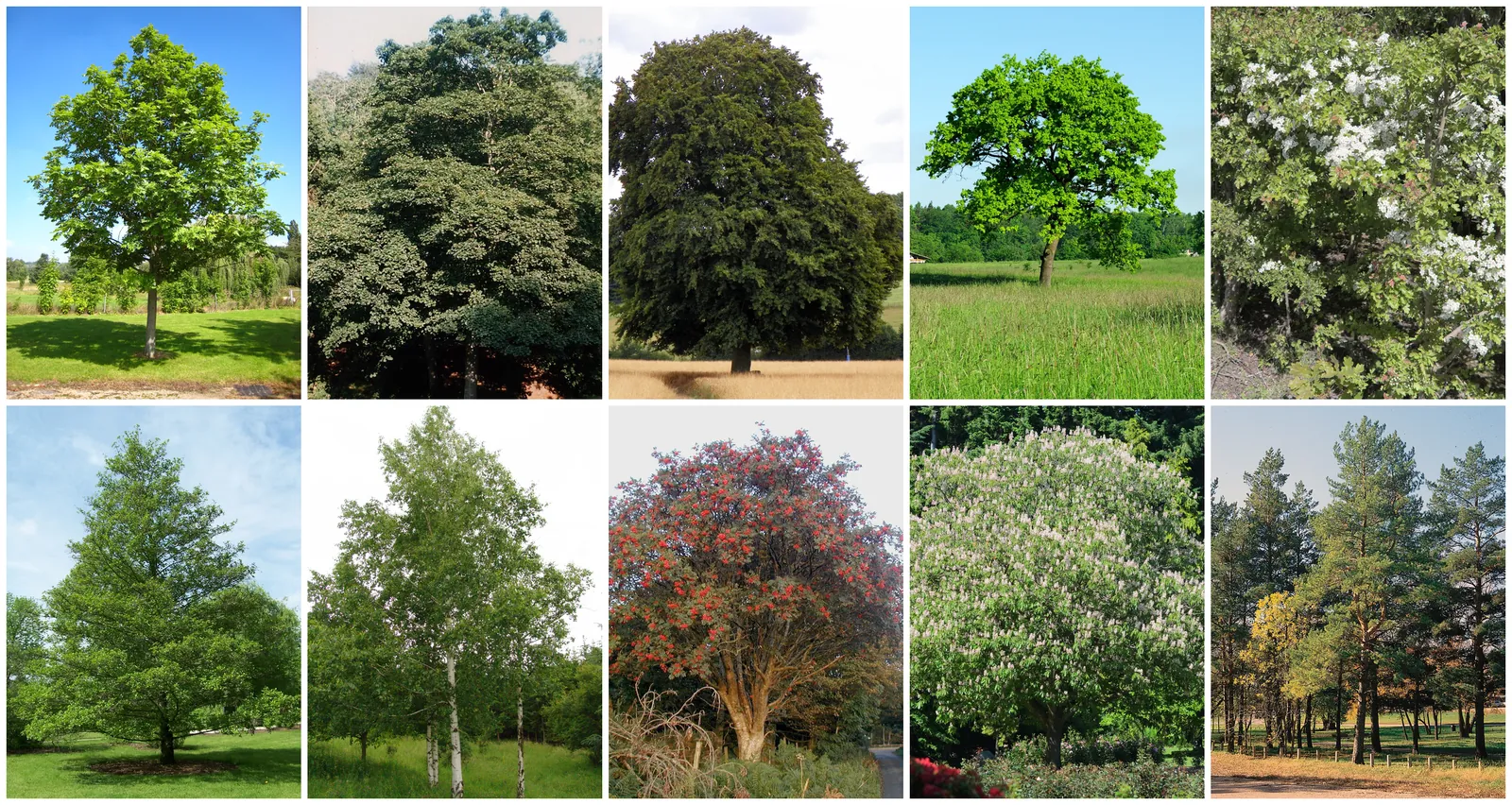
This guide gives the fastest identification for each, the one thing worth knowing about it, and a link to the full article if you want the detail.
The fastest way to identify any tree
Before the species list, the method. Professionals do not identify trees by staring at the whole thing; they work through a short sequence, and it works in every season.
- Leaf arrangement. Are the leaves and buds in opposite pairs, or alternating along the shoot? Opposite is unusual and immediately narrows the field: ash, sycamore, horse chestnut and maple. Everything else on this list is alternate.
- Leaf type. Simple (one blade) or compound (divided into leaflets)? Ash and rowan are compound; horse chestnut is palmate.
- Bark. Smooth, fissured, flaking or peeling, and what colour.
- Buds and twigs in winter. Often more reliable than leaves, and always available.
- Where it is growing. Wet ground, exposed hilltop, old demesne, hedgerow. Habitat narrows the answer before you look at anything.
1. Ash
Identify by: sooty black buds in opposite pairs on flattened grey twigs; long pinnate leaves; light, open crown. Worth knowing: ash dieback is now everywhere, but a thin crown alone does not condemn a tree. The danger is secondary decay at the base, which is why ash needs assessing at ground level, not from a car window. Full guide to ash
2. Sycamore
Identify by: five-lobed leaves in opposite pairs; winged seeds set at 90 degrees; flaky, patchwork bark. Worth knowing: the black spots on the leaves are harmless tar spot, and actually indicate clean air. The thing to take seriously is sooty bark disease, black spore dust beneath lifting bark. Full guide to sycamore
3. Beech
Identify by: smooth grey bark stretched over swelling buttresses; long pointed copper buds; wavy-edged leaves; brown leaves held all winter on young trees. Worth knowing: beech roots are shallow, wide and unforgiving of disturbance. Most beech killed by construction dies three to five years after the works, long after anyone connects the two. Full guide to beech
4. Oak
Identify by: deeply lobed leaves with rounded lobes; clustered buds at the shoot tip; heavy fissured bark; massive spreading limbs. Worth knowing: a hollow trunk is a normal part of a long oak life rather than a reason to fell, and Tree Preservation Orders apply to specified trees rather than to species, so being an oak confers no protection in itself. Full guide to oak
5. Hawthorn
Identify by: short straight thorns; small deeply lobed leaves; white May blossom; red haws in autumn. Worth knowing: hedgerow cutting is an offence between 1 March and 31 August, and a lone thorn in a field is left standing for reasons that are worth respecting even if you do not share them. Full guide to hawthorn
6. Alder
Identify by: small woody cones on the twigs all year; rounded leaves with a blunt or notched tip; growing in wet ground. Worth knowing: alder fixes its own nitrogen and hardens under water. Dark tarry bleeding at the base signals Phytophthora, which moves downstream through a catchment. Full guide to alder
7. Silver birch
Identify by: white peeling bark with black diamond fissures at the base; fine drooping shoots; small triangular toothed leaves. Worth knowing: birch is low-risk near buildings on our soils, but it is short-lived. A birch declining at 50 is usually old, not ill, and it fails suddenly once decay sets in. Full guide to silver birch
8. Rowan
Identify by: pinnate leaves that alternate along the shoot (ash leaves sit in opposite pairs); dense clusters of scarlet berries; smooth grey bark. Worth knowing: the best small-garden tree we have for Northern Irish conditions, and the one traditionally planted at the door for protection. Full guide to rowan
9. Horse chestnut
Identify by: hand-shaped palmate leaves; big sticky buds; upright white flower candles in May; conkers. Worth knowing: the brown leaves every August are leaf miner and essentially harmless. Dark bleeding on the trunk is bleeding canker and is not. Look at the trunk, not the leaves. Full guide to horse chestnut
10. Scots pine
Identify by: orange-pink bark on the upper trunk; needles in pairs; flat-topped crown on a long clean stem. Worth knowing: shelterbelts behave as a single system. Removing part of one exposes trees that have never carried full wind loading alone, and the next gale finds them. Full guide to Scots pine
What is missing from this list, and why
Willow, hazel, holly, elder, whitebeam, lime, Scots elm and a range of conifers are all common here without making the top ten. Elm deserves a specific mention: it was once one of our defining hedgerow trees and Dutch elm disease removed it within a generation, which is worth remembering whenever anyone suggests that the current run of tree diseases is unprecedented. It is not; it is the third such event in a century.
Wych elm still persists in Ireland in scattered pockets and young hedgerow regrowth, and if you find a tree with strikingly asymmetric leaf bases and rough, sandpapery leaves, look again.
Trees, mortgages and property purchases
One question deserves its own section, because it is the commonest reason people go looking for a tree consultant at all: a mortgage report has raised the trees at a property, and the purchase is now waiting on an answer.
Lenders and building surveyors raise three things. Falling distance, meaning whether a tree could strike the building if it failed. Root influence, which on shrinkable clay soils can contribute to subsidence. And future growth, since a tree that is manageable today may dominate the plot over the term of a mortgage.
Species matters here, but less than people assume, and not in the order they expect. The guidance used in foundation design classifies trees by water demand: oak and hawthorn are high, most of this list including ash, sycamore, beech, alder, rowan and horse chestnut are moderate, and birch is low. What matters more than the species is whether shrinkable clay is actually present beneath the building, which is far less common in Northern Ireland than in the clay belts of south-east England.
One counterintuitive point worth knowing: felling a large, high water demand tree on clay can cause heave as the soil rehydrates, sometimes doing more damage than leaving it. Removal is not automatically the cautious choice.
If a lender or surveyor has queried trees at a property you are buying, a mortgage tree report answers all three questions in the format underwriters recognise, typically within 48 to 72 hours of the site visit, and our guide to how a tree survey can improve your mortgage report explains the process from the buyer's side.
What to do once you know what you have
Identification is the start of the conversation, not the end of it. Whichever of the ten you have, the questions an arboriculturist asks are the same three:
- What is the tree's condition, honestly assessed, and how much useful life does it have left?
- What sits beneath it, because risk is a function of targets as much as of trees?
- What is planned nearby, since most avoidable tree damage in Ireland is caused by construction rather than disease?
If your tree stands near a proposed development, a BS 5837 tree survey answers the third question in the form planning authorities require. If it overhangs a house, a road or a place people gather, a tree risk assessment answers the first two proportionately, without the reflexive felling that costs Northern Ireland good trees every year. If a lender has queried trees during a property purchase, a mortgage tree report resolves it in 48 to 72 hours. And if you have lost a tree and want the right replacement, our tree planting advice starts from your site rather than from a catalogue.
We are an independent arboricultural consultancy working across Northern Ireland and Ireland, and we carry out no tree works of any kind, which means that when we tell you a tree is fine as it stands, there is nothing in it for us. Send us the site details and you will get a straight answer.