
Beech Tree Identification, Root Problems and Care in Northern Ireland
Smooth grey bark, copper leaves through winter and a root system that will not forgive building work. Beech identification, problems and honest care advice.
Written by John McNamara, arboricultural consultant, McNamara Tree Consultancy. Holds Professional Tree Inspection (PTI) certification and is an Associate Member of the Arboricultural Association. View John's qualifications and experience
Beech, Fagus sylvatica, is the tree people describe as looking like an elephant's leg, and once you have heard that you never unsee it. That smooth, silvery-grey bark stretched taut over swelling buttress roots is the fastest identification in the woodland, and it is also the tree's greatest vulnerability: beech bark is thin, it has no protective corky layer, and it never heals damage the way oak does.
In Northern Ireland beech is everywhere in the designed landscape. The great demesne avenues, the estate boundaries, the shelterbelts around Georgian houses: much of the mature beech here was planted deliberately in the eighteenth and nineteenth centuries, which is why so many of our finest specimens are now arriving at the same stage of life together.
How to identify a beech tree
Bark. Smooth, grey, unfissured even on very old trees, often with horizontal ripples and a faint sheen. If it is a big tree and the bark is smooth, it is almost certainly beech or hornbeam. Hornbeam has a fluted, muscular trunk that looks as if it has been carved; beech is round and swollen.
Buds. Long, slender, sharply pointed and copper-brown, held at an angle to the shoot rather than pressed against it. In winter these are diagnostic and beautiful.
Leaves. Oval, pointed, with a distinctly wavy (not toothed) margin and silky hairs fringing the edge when young. Fresh beech leaves in May are one of the best greens in the Irish year.
Winter marcescence. Young beech and the lower branches of older trees hold onto dead coppery leaves all winter. This is why beech makes such a good hedge: it screens through the cold months without being evergreen.
Nuts. Triangular beech mast in bristly husks, produced in heavy quantities every few years.
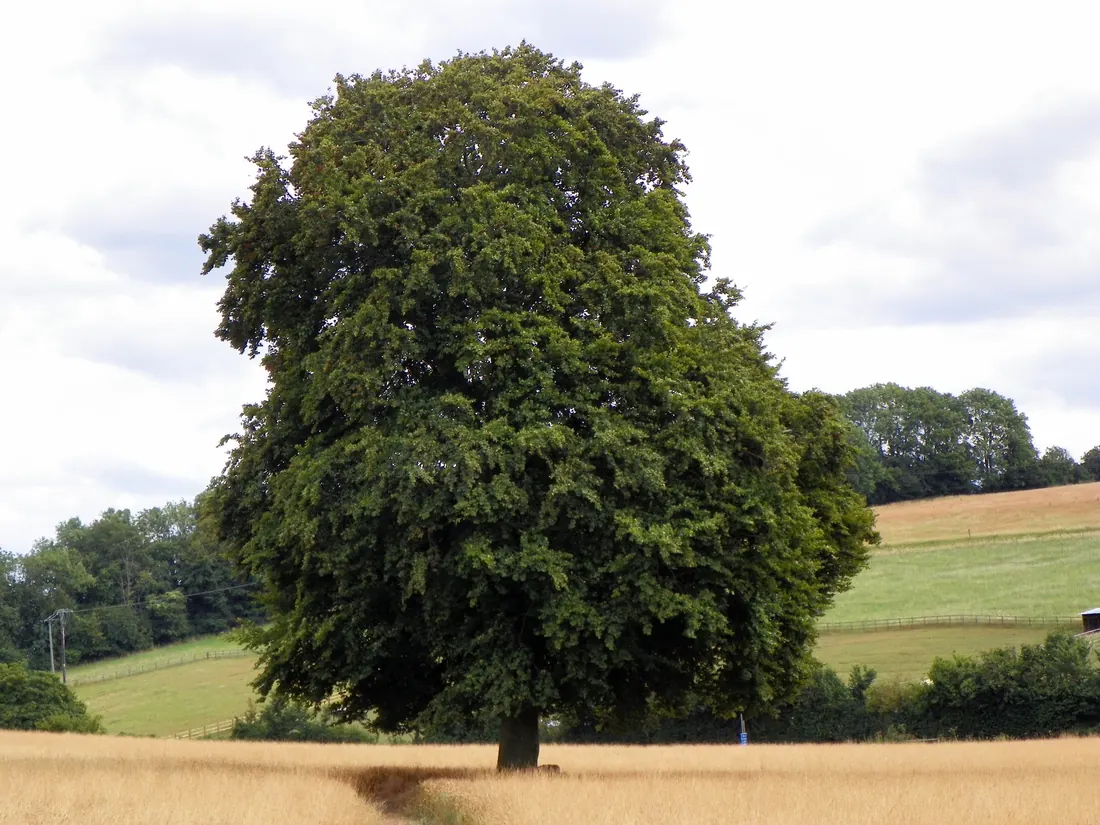
Why beech and building work go badly together
If there is one thing worth knowing about beech, it is this: its roots are shallow, wide and remarkably intolerant of disturbance. A beech spreads a dense mat of fine roots through the top 60cm of soil, often extending well beyond the crown. It has very little deep anchorage compared with oak.
The consequences follow logically. Trenching for services within the root zone can remove a substantial share of a beech's working roots in a single afternoon. Raising ground levels by even 150mm of soil or hardcore suffocates those surface roots, and beech shows the damage slowly, dying back over three to five years, long after the contractor has left and usually long after anyone connects cause and effect. Compaction by plant and site traffic does the same thing more gradually.
This is exactly what the root protection area in BS 5837:2012 exists to prevent, and it is why with beech the calculated RPA should be treated as a genuine exclusion zone rather than an inconvenience to be negotiated. Where a beech is close to proposed works, an Arboricultural Method Statement setting out no-dig construction, hand digging or a redesigned route for services is not bureaucracy; it is the difference between keeping the tree and paying to remove a dead one in five years' time.
The same shallow rooting makes mature beech comparatively vulnerable to windthrow when its neighbours are felled or when the soil is waterlogged in winter storms, which is worth remembering before clearing around one.
Common beech problems
Sunscald. That thin bark burns. When a beech that grew up in a group is suddenly exposed on its south or south-west side, the bark can be killed outright, cracking and falling away years later. Another reason to think hard before removing a beech's neighbours.
Meripilus giganteus. The giant polypore, a large brown bracket fungus appearing in overlapping tiers at the base, is one of the findings that most changes decisions on mature beech. It decays major structural roots while the crown can still look reasonably healthy, and it is associated with windthrow and whole-tree failure. If you find large brackets at the foot of a mature beech that overhangs anything, that is a case for prompt professional assessment through a tree risk assessment, not a wait-and-see.
Drought stress. Beech is the first of our large broadleaves to show a dry summer, with early leaf browning and premature fall. One dry year is survivable; several in succession, combined with root damage, is what pushes old beech over the edge.
Beech hedges and garden beech
For gardens, beech hedging remains outstanding: dense, formal, and holding its russet winter leaves. Trim in late summer, once, and it will stay tight for decades.
A full-sized beech is a different proposition. It will eventually reach 30 metres or more with a crown spread to match, its shade and surface roots make gardening beneath it nearly impossible, and it does not take kindly to being repeatedly cut back. If you are choosing a tree for a modest garden because you admire the beech in the park, our tree planting advice will steer you to something that gives you the same feeling at a workable scale.
Beech trees and property purchases
A mature beech close to a house almost always attracts a comment from a building surveyor, because of its sheer size rather than anything specific to the species.
Beech is a moderate water demand tree, so on shrinkable clay it warrants consideration but is not in the highest category. Its more relevant characteristics for a purchase are the ones covered above: a wide, shallow root plate that dislikes disturbance, and a crown that can easily overhang a roof.
There is a practical consequence worth knowing. Because beech roots run near the surface and well beyond the crown, works around a property, extensions, new drives, drainage, are where the real risk to the tree lies. A report that only answers the lender's question and says nothing about protecting the tree during future works has done half the job.
Our mortgage tree reports cover both, and where the beech is affected by planned works, a BS 5837 tree survey is the right next step.
Buying a property with a beech tree nearby? McNamara Tree Consultancy provides mortgage tree reports in Northern Ireland and Ireland. The inspection and the report are carried out by John McNamara, who holds Professional Tree Inspection (PTI) certification. If your lender or surveyor has raised a concern about a beech tree, send us their written request and the property location so we can confirm the assessment required, the report scope and the timescale. View John's qualifications and experience.
If you have a beech near a building or a project
The two questions that matter are what is happening at the base of the tree, and what is planned within its rooting area. Beech gives less warning than most species on both counts, which is precisely why it repays professional attention early rather than late.
Send us the site details and you will get clear advice on whether your beech needs a formal assessment, a survey for a planning application, or simply to be left alone with its roots undisturbed.