
Hawthorn Identification, Hedgerows and the Fairy Thorn in Northern Ireland
The most abundant tree in the Irish landscape, and the one with the most rules attached, legal and otherwise. Hawthorn identification, hedgerow law and care.
Written by John McNamara, arboricultural consultant, McNamara Tree Consultancy. Holds Professional Tree Inspection (PTI) certification and is an Associate Member of the Arboricultural Association. View John's qualifications and experience
Count the trees in a mile of Northern Ireland countryside and most of them will be hawthorn. Crataegus monogyna built our field system: it is thorny, it grows fast, it takes hard cutting and it stays stock-proof, which is why the eighteenth and nineteenth-century enclosures were planted with it from Down to Donegal. It also carries more folklore than any other tree here, and that folklore has real consequences for what gets felled and what does not.
How to identify hawthorn
Thorns. Straight, sharp, 1 to 2cm, growing directly from the shoot. Blackthorn's thorns are longer, blacker and set on darker bark, and blackthorn flowers before its leaves appear while hawthorn leafs first, then flowers. That sequence is the reliable spring separator.
Leaves. Small, deeply lobed almost to the midrib, glossy dark green, held in clusters on short spurs.
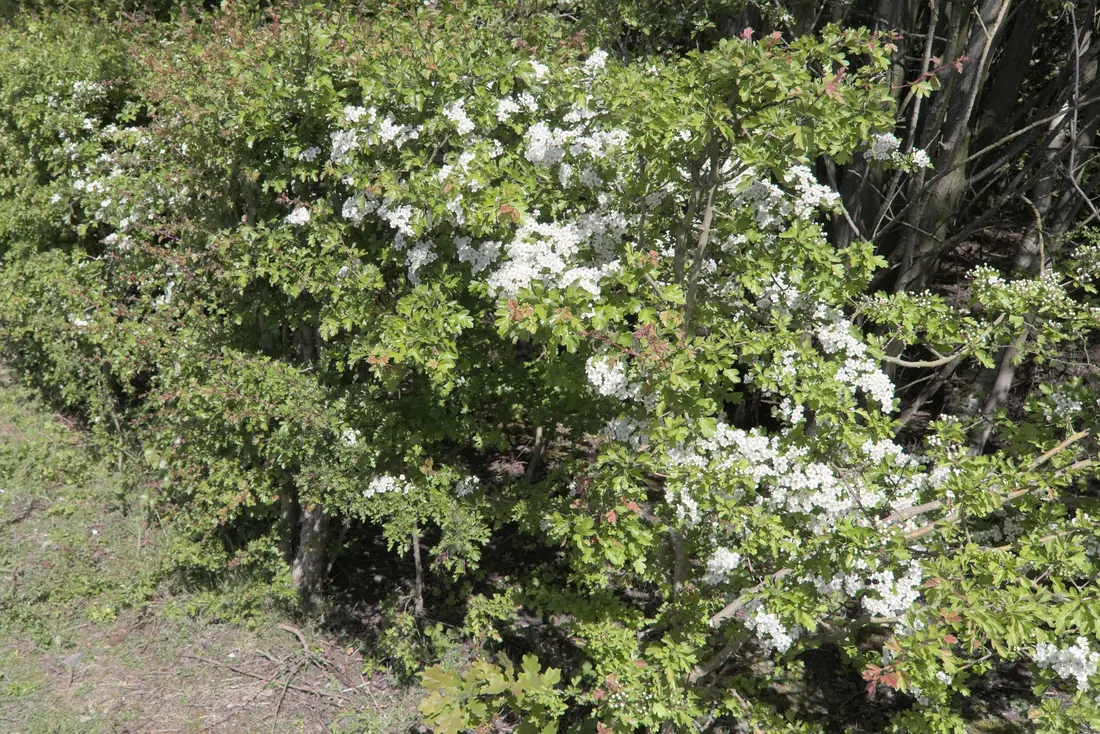
Flowers. Dense clusters of white (occasionally pink-flushed) blossom in May, hence "may blossom" and hence the month's association with it. The scent is strong and, honestly, not to everyone's taste; it contains the same compound produced by decaying tissue, which is part of why it attracts the flies that pollinate it and part of why old superstition kept it out of the house.
Haws. Deep red single-seeded berries from late summer, persisting into winter and one of the most important bird foods in the Irish landscape. Midland and Blackthorn confusion clears here too: sloes are blue-black with a waxy bloom.
Form. Usually a dense multi-stemmed shrub in a hedge; as a free-standing tree it makes a low, wind-sculpted dome, often leaning away from the prevailing wind.
Hedgerow cutting: the law you need to know
This is the practical point that catches landowners out every year, and the rules are less uniform than people assume. In Northern Ireland, wild birds and their active nests are protected under the Wildlife (Northern Ireland) Order, so cutting a hedge with nests in it is an offence at any time of year. The familiar 1 March to 31 August closed season for hedge cutting is a condition of the farm support schemes, applying to agricultural land under the Farm Sustainability Standards that replaced Cross-Compliance in 2026, rather than a blanket legal ban on every garden hedge. In the Republic, section 40 of the Wildlife Acts prohibits cutting hedges between 1 March and 31 August, with exemptions that include ordinary gardening and road safety work. The safe rule everywhere is the same: keep significant hedge work out of the nesting season, check for nests before any cutting, and confirm the current DAERA or NPWS guidance if the hedge is on farmland.
There are exemptions, including works necessary for road or public safety, but they are narrower than people assume, and "it needed doing" is not one of them. If you are relying on an exemption, be sure which one. If hedge work is required on a development site, it needs to be planned into the programme outside that window or justified properly, which is one of the details that belongs in an Arboricultural Method Statement rather than being discovered by a site manager in June.
Hedgerows also frequently carry more ecological weight in a planning determination than the individual trees within them. A mature, species-rich hedge with standard trees is a habitat feature, and removing one usually requires replacement planting as a condition. That is worth knowing at design stage, when the layout can accommodate it cheaply, rather than at determination. Our BS 5837 tree surveys record hedgerows and their standards precisely because they so often shape what a scheme can do.
The fairy thorn
A lone hawthorn standing untouched in the middle of a field is one of the most characteristic sights in Ulster, and there is a reason it is still standing. Lone thorns, particularly at raths, forts and boundaries, are traditionally associated with the fairies, and the belief that felling one brings misfortune remains genuinely current in rural areas. Road schemes have been diverted around them within living memory.
It is not our place to arbitrate folklore, but it is our place to point out that these trees are usually ecologically valuable, ancient, and entirely harmless where they stand. If a lone thorn falls within a development site, the practical advice is the same as the traditional advice: design around it. That decision costs almost nothing and avoids a fight with the local community that costs a great deal.
Common hawthorn problems
Fireblight. Erwinia amylovora affects members of the rose family including hawthorn, causing shoots to wilt, blacken and curl into a shepherd's crook as if scorched. There is no chemical control; management is cutting well back into healthy wood in dry weather and disposing of the material.
Hawthorn rust. Orange spots on leaves, spectacular but rarely damaging, and requiring juniper nearby to complete its life cycle.
Overgrown hedges. The commonest issue is not disease but neglect. A hawthorn hedge left uncut for twenty years becomes a line of leggy small trees with gaps at the base and no stock-proofing at all. The traditional remedy, hedge laying, remains the best one: partially cutting and bending the stems to regenerate dense growth from the bottom. Coppicing works too. Both are winter jobs, for the legal reason above.
Hawthorn in gardens
For a small garden, hawthorn is genuinely underrated. It stays modest, it flowers, it feeds birds through winter, it tolerates wind and poor soil, and it will grow where more fashionable trees sulk. The thorns are a consideration where children play, and the cultivar 'Paul's Scarlet' offers double red flowers at the cost of producing no haws for wildlife, which is a trade worth making consciously. Our tree planting advice frequently comes back to hawthorn and rowan for exactly the exposed, small-space situations where people are tempted to plant something that will outgrow the site in fifteen years.
Hawthorn and mortgage queries
Hawthorn surprises people in this context. Despite being a small tree, it is classed as high water demand in the guidance used for foundation design, in the same category as oak and willow.
That sounds worse than it usually is. Water demand is only half the equation; the other half is the tree's mature size, and a hawthorn's is modest. Its zone of influence is correspondingly small, so a hawthorn hedge or a lone thorn at the far end of a garden is rarely a structural question at all. A mature hawthorn growing tight against a wall on shrinkable clay is a different matter, and worth assessing properly.
Hedges raise their own point during purchases: boundary responsibility and the legal restrictions on when they can be cut, which is worth knowing before completion rather than after.
If trees or hedgerows have been raised in a mortgage report, our mortgage tree reports address them against the surveyor's exact wording.
Hedgerow or thorn on your project?
If you have a hedgerow, a boundary of hawthorn or a lone thorn affected by a development, the questions to answer early are what the hedge is worth ecologically, when it can lawfully be worked on, and whether the design can retain it.
Send us the site details and you will get clear advice before the programme is fixed, which is when the answer is still cheap to act on.