
Rowan Tree Identification, Berries and Garden Care in Northern Ireland
Ash-like leaves, brilliant red berries and a place in every Irish superstition worth knowing. Rowan identification, why it suits small gardens, and how to care for one.
Written by John McNamara, arboricultural consultant, McNamara Tree Consultancy. Holds Professional Tree Inspection (PTI) certification and is an Associate Member of the Arboricultural Association. View John's qualifications and experience
Rowan is the tree that answers the question people actually ask. They want something that flowers, feeds birds, colours in autumn, tolerates wind and rain, and never threatens the house. Sorbus aucuparia does all five, which is why it is the tree we recommend more often than any other for small gardens in Northern Ireland.
Its other name, mountain ash, causes constant confusion. It is not an ash and is not related to one. It simply has leaves that look like ash leaves and a willingness to grow at altitude where true ash gives up.
How to identify a rowan
Leaves. Pinnate, with 5 to 8 pairs of narrow, sharply toothed leaflets and a single terminal leaflet. Against true ash the differences are clear once seen: rowan leaflets are narrower, distinctly toothed all round and usually a duller green, while ash leaflets are broader and the whole leaf is much larger. Rowan leaves also alternate along the shoot; ash leaves sit in opposite pairs. That last point is the one to remember.
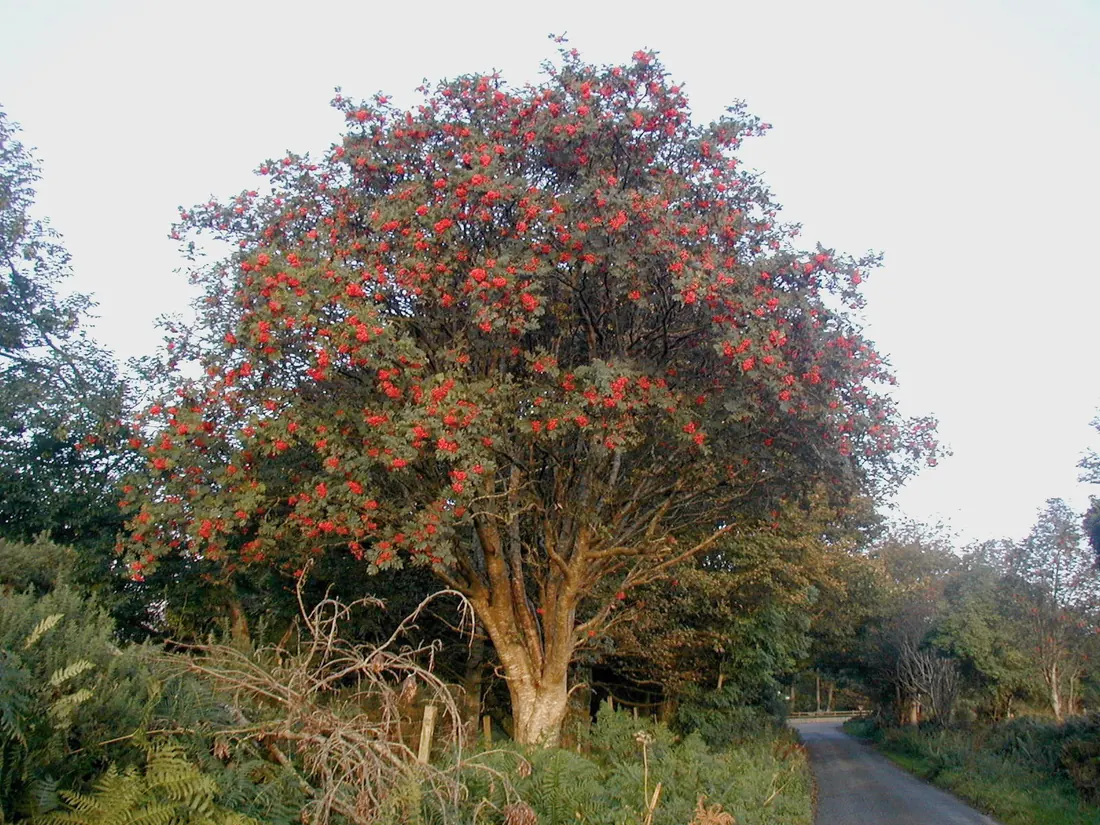
Berries. Dense clusters of scarlet berries from August, one of the great sights of the upland Irish landscape and one of the most valuable bird foods available. Blackbirds, thrushes and, in some winters, waxwings strip a tree in days.
Flowers. Flat-topped clusters of small creamy-white flowers in May, with a heavy, slightly sweet scent.
Bark and form. Smooth, shining grey-brown with prominent horizontal lenticels, on a slender trunk. A small tree, typically 8 to 12 metres, with an upright then spreading crown that never becomes heavy.
Buds. Purple-tinged, hairy, pressed close to the shoot.
Why rowan suits Irish gardens
Rowan is native, hardy to real exposure, indifferent to acid soil, tolerant of thin ground, and small enough that its mature size is never a threat to a building. It will grow at 600 metres on a Mourne hillside and it will grow in a Belfast front garden.
For anyone weighing up a tree for a modest space, the arithmetic matters: a rowan at full size occupies about the footprint of a large shed, whereas the oak or beech people often admire and then plant will eventually occupy the whole garden and half the neighbour's. Choosing correctly at planting is the cheapest tree work anyone ever does, and it is the core of our tree planting advice.
Cultivars are worth knowing about. 'Sheerwater Seedling' is narrowly upright and good for tight spaces; Sorbus vilmorinii and 'Joseph Rock' give pink and yellow berries respectively, though native red-berried rowan feeds birds best.
Rowan and the folklore
Of all Irish trees, rowan carries the strongest protective reputation. It was planted at doorways and byres to guard against harm, and rowan crosses bound with red thread were a common household charm well into the twentieth century. Unlike the lone hawthorn, which folklore says must not be cut, rowan was the tree you deliberately planted close to the house. If a client tells you their grandmother planted the rowan by the door for a reason, that is exactly why.
Common rowan problems
Fireblight. Rowan is in the rose family and is susceptible to Erwinia amylovora. Shoots wilt suddenly, blacken as if scorched, and hook over at the tip. There is no treatment; cut well back into clean wood in dry weather, disinfecting tools between cuts, and burn or remove the material.
Silver leaf. Chondrostereum purpureum gives a metallic sheen to the foliage and can kill branches progressively. Prune in summer, never in winter, to reduce infection risk.
Short life. Rowan is not a long-lived tree, often 80 to 120 years and frequently less in a garden. A rowan that has thinned and become sparse at 60 is usually ageing, not sick.
Aphids and honeydew. Common, unsightly, rarely damaging.
Because rowan is small, most problems are manageable and few pose a safety issue. The exception is a leaning or decayed rowan directly over a driveway or seating area, where a straightforward tree risk assessment settles the question quickly.
Caring for a rowan
Very little intervention is needed or wanted. Prune only in summer and only to remove dead, damaged or crossing branches. Keep the base clear of grass for the first few years after planting, mulch rather than feed, and water through the first two dry summers. Do not reduce the crown for the sake of it; rowan's charm is its natural, open shape and it does not recover well from heavy cutting.
If a rowan is failing after decades, the right response is often to plant its replacement nearby and let the two overlap, so the garden never has a gap. That kind of succession planning is standard practice in parks and almost unknown in gardens, and it is one of the most useful habits any owner can adopt.
Rowan and property purchases
Rowan almost never causes a problem in a mortgage context, and that is worth saying plainly.
It is a small tree of moderate water demand, and its mature size means its influence on a building is limited even at close quarters. Where a surveyor mentions a rowan it is usually as part of a general note about garden trees rather than a specific concern.
Rowan's more common role in these conversations is as the answer rather than the problem. Where a large tree genuinely does have to be removed near a property, rowan is frequently the right replacement: it satisfies the wish to keep a tree, it will not repeat the issue, and it establishes quickly.
If a lender has queried trees at a property you are buying, our mortgage tree reports answer the question properly, and our tree planting advice covers sensible replacements.
Advice on your rowan
Rowan rarely needs professional attention, which is part of why it is such a good choice. Where it does, the questions are the usual ones: what is over the target, and what is happening at the base.
Send us the details if you are unsure, or read our guide to the ten most common trees in Northern Ireland if you are still working out what you have.