
Sycamore Tree Identification, Problems and Management in Northern Ireland
Vigorous, unloved and everywhere. Sycamore is the tree people most often want removed, and the one most often misjudged. Here is how to identify and manage it.
Written by John McNamara, arboricultural consultant, McNamara Tree Consultancy. Holds Professional Tree Inspection (PTI) certification and is an Associate Member of the Arboricultural Association. View John's qualifications and experience
No tree in Ireland divides opinion like sycamore. Acer pseudoplatanus is not native, it seeds itself into every neglected corner, and it is the species people most often ring an arboriculturist about wanting rid of. It is also, quietly, one of the most useful trees we have: it tolerates salt-laden wind and urban pollution better than almost any broadleaf, which is why it shelters so many farmsteads along the Antrim coast and stands in so many town squares where nothing else would thrive.
Knowing which sycamore is a nuisance and which is doing a job is the difference between a sensible decision and an expensive mistake.
How to identify a sycamore
Leaves. Five lobes, palmate, arranged in opposite pairs, dark green above and paler beneath, typically 10 to 15cm across with a leaf stalk that often carries a reddish tinge. The classic confusion is with Norway maple, whose lobes taper to fine bristle points and whose leaf stalk bleeds milky sap when snapped. Sycamore lobes are blunter, the leaf feels thicker and slightly leathery, and no milk appears.
Seed. The unmistakable "helicopters", paired winged samaras set at roughly a 90-degree angle to each other. Norway maple's wings are set almost flat, close to 180 degrees. Once you have that angle in your eye you can name either tree from the ground in autumn.
Bark. Smooth and pinkish grey when young, becoming scaly and flaking away in irregular plates on mature trees to leave an orange-brown patchwork underneath. That flaky, camouflage-patterned bark is the quickest winter identification.
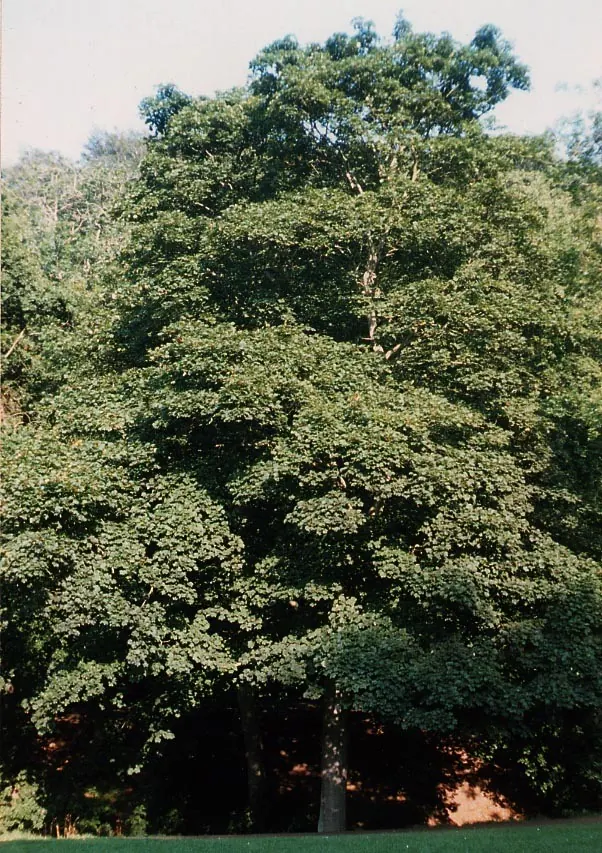
Silhouette. A broad, heavy dome on a stout trunk, densely twigged and casting deep shade. Where ash lets the sky through, sycamore closes it out, which is exactly why grass struggles beneath one and why they are so effective as shelter.
Tar spot. Large black blotches with yellow haloes appearing on the leaves from midsummer. Almost every sycamore in Ireland has it. It is Rhytisma acerinum, it is cosmetic, and it harms nothing. It is also often taken as a sign of clean air, since the fungus is sensitive to sulphur dioxide pollution, so heavily spotted leaves tend to indicate a clean airshed rather than a sick tree.
The problems that are real, and the ones that are not
Sycamore generates more unnecessary tree work than any other species here, so it is worth separating the genuine issues from folklore.
Genuine: seedlings. A mature sycamore produces enormous quantities of viable seed, and it germinates in gutters, borders, gravel and hedge bottoms. If you have one over a garden you will be weeding its offspring every spring. That is a maintenance reality, not a defect.
Genuine: shade and honeydew. The dense crown casts heavy shade, and sycamore aphids produce a sticky honeydew that coats cars and patios in summer, later blackening with sooty mould. Both are strong arguments for crown thinning or, occasionally, for the right tree being in the wrong place.
Genuine, and serious: sooty bark disease. Cryptostroma corticale has become significantly more common in these islands after hot summers. It shows as bark cracking and lifting to reveal a layer of black, soot-like spores beneath, along with dieback in the crown. It can kill mature trees, the spores are a respiratory irritant, and affected trees near targets need prompt professional assessment. If you find black dust under lifting bark on a sycamore, that is the one time to treat it as urgent, and a tree risk assessment is the right response.
Usually overstated: "sycamore roots wreck foundations". Sycamore has a strong, spreading root system and it does draw moisture from the soil. Subsidence associated with trees, though, depends primarily on the soil: it is a risk where shrinkable clays are present, and the species most often implicated are the high water demand ones, poplar, willow, oak and elm. Sycamore sits in the moderate group. Whether it matters at your property depends on the ground beneath it rather than on the species alone, which is why a report answers the question and a rule of thumb does not. Lifted paving, boundary walls and already-failing drains are more common complaints than structural damage. If your sycamore is close to a house and the real question is whether it matters, a tree condition survey looks at the tree and the ground together and gives you an answer specific to your property rather than to the species.
Sycamore and planning applications
Because sycamore is so widespread on field boundaries and old estate walls, it appears constantly in BS 5837 tree surveys. Two things are worth knowing before you assume a design can simply ignore it.
First, sycamore can absolutely be a category A or B tree. Its non-native status has no bearing on its BS 5837 category, which is judged on condition, amenity value and remaining contribution. A large, healthy sycamore screening a development from a road is often the most valuable tree on the site.
Second, Tree Preservation Orders apply to sycamore exactly as they do to oak. A great many people have discovered this the expensive way, because "it's only a sycamore" is not a defence. If the tree is in a conservation area or you have any doubt, check before anyone touches it.
Managing a sycamore well
The usual answer for a garden sycamore that has outgrown its space is not removal but a proportionate crown reduction and thin on a cycle, which lets light through, reduces sail area and keeps the tree in scale. Sycamore responds well to pruning and compartmentalises decay reasonably, which is more than can be said for many species.
Avoid two things. Do not top it: sycamore responds to heavy topping with dense, weakly attached regrowth that becomes a bigger problem in a decade. And do not prune it in spring, when it bleeds sap heavily; late summer is far better.
Where a sycamore genuinely has to go, remember what it was doing. If it was sheltering a yard from the prevailing south-westerly, removing it exposes everything behind it, including other trees that grew up in its lee and have never carried wind loading on their own. That is a common cause of failures the following winter, and it is one of the things we assess before recommending anything.
Sycamore and mortgage reports
Sycamore comes up in property purchases more than most species, simply because it is so often the large tree nearest the house.
For water demand it sits in the moderate group, which puts it below oak, poplar, willow and elm. That matters, because tree-related subsidence depends first on whether shrinkable clay is present beneath the building and only then on the species. A moderate-demand tree on ground that does not shrink is not a structural concern, whatever its size.
What a surveyor is more likely to be flagging is a large crown overhanging the roof, roots lifting a drive or boundary wall, or an old drain run in the tree's rooting zone. Those are answerable questions with practical remedies, not reasons to fell a healthy tree.
If a lender has asked for an arboricultural opinion, our mortgage tree reports address falling distance, root influence and future growth directly against the wording of their request.
Not sure whether yours is a problem?
If you have a sycamore you are weighing up, the useful questions are whether the bark is sound, what the crown is doing above the target, and what work has been done to it in the past. Send us the details and you will get a straight answer, including the answer "leave it alone" when that is the right one. We carry out no tree works, so there is nothing to sell you either way.