Ash Tree Identification, Dieback and Care in Northern Ireland
Black buds, pinnate leaves and a crown you can see the sky through. Here is how to identify ash, recognise dieback honestly, and decide what to do about it.
Written by John McNamara, arboricultural consultant, McNamara Tree Consultancy. Holds Professional Tree Inspection (PTI) certification and is an Associate Member of the Arboricultural Association. View John's qualifications and experience
If you are trying to name a tree in winter and you find buds like small black velvet cones sitting opposite each other on a pale grey shoot, you can stop looking. That is ash, Fraxinus excelsior, and no other native tree in Ireland or Britain carries that combination. It is the single most reliable identification feature in our flora, and it works from a car window at twenty paces.
Ash matters here more than most species. It is one of the commonest trees in the Northern Ireland landscape, threaded through every hedgerow, field boundary and townland from Antrim to Fermanagh. It is also the tree at the centre of the most significant disease event in a generation, which means that "what kind of tree is this?" and "is my tree dying?" are increasingly the same question.
How to identify an ash tree
Work through the tree from the twig inwards, which is how any arboriculturist does it.
Buds. Sooty black, pyramidal, and arranged in opposite pairs along a smooth grey-green twig that is noticeably flattened at the nodes. The terminal bud sits like a bishop's mitre at the tip. Nothing else looks like it.
Leaves. Pinnate, meaning each leaf is made of several pairs of leaflets (usually 4 to 6 pairs) with a single leaflet at the tip. The whole leaf can be 30cm long, which is why people often mistake a single ash leaf for a small branch. The overall effect in summer is light and feathery: ash casts one of the lightest shades of any large broadleaf, which is precisely why grass grows so well beneath it and why it is such a good farmland tree.
Bark. Pale grey and smooth on young stems, developing a fine, regular diamond pattern of shallow fissures with age. On a very old ash the ridges become broader and rougher, but the pattern stays orderly, unlike the deep, chaotic corrugation of oak.
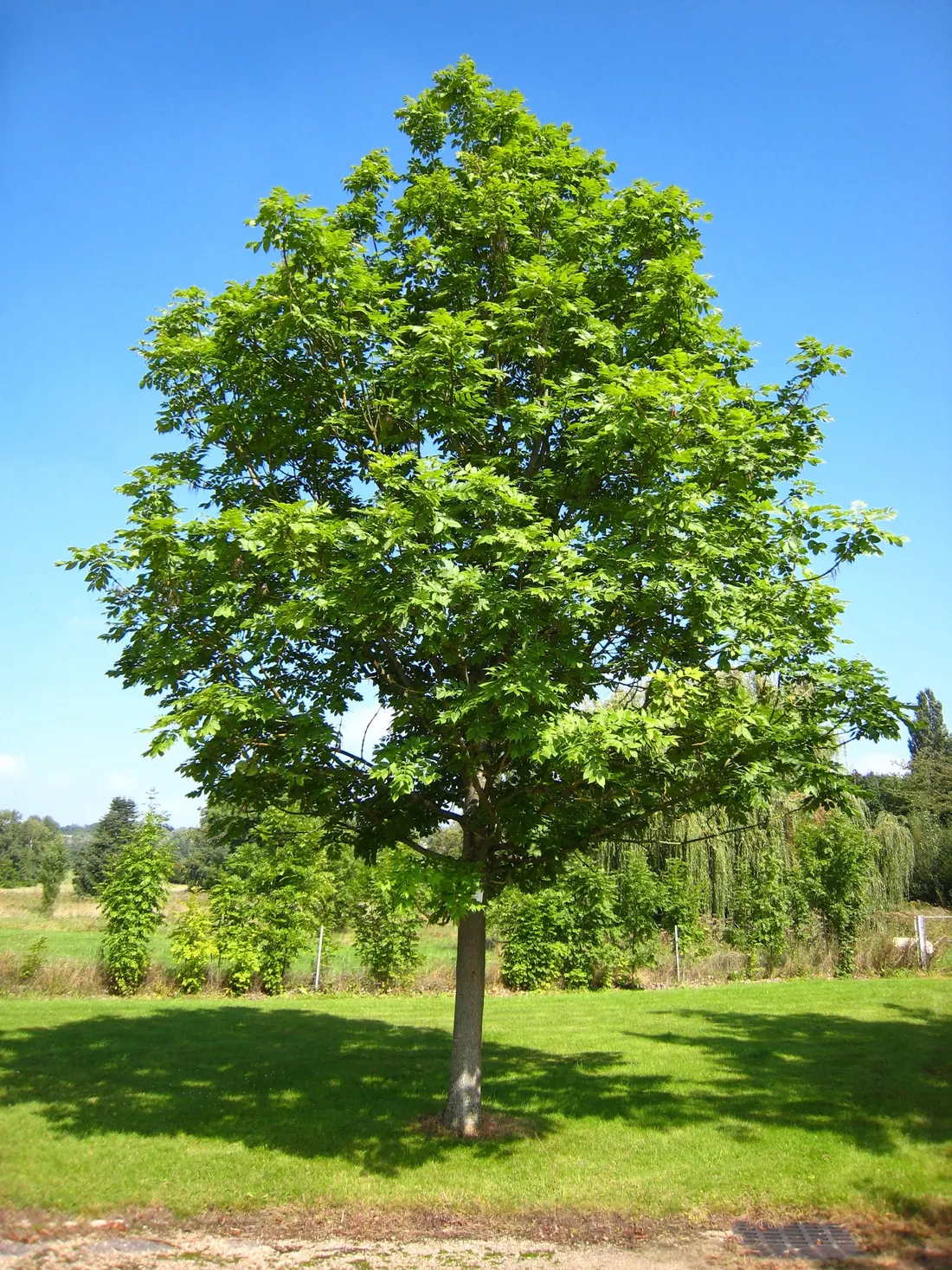
Silhouette. Upswept, open and slightly untidy, with branches that sweep down and then turn up at the tip, giving the tree a raised-arm posture. In winter you can see a great deal of sky through an ash crown even when it is in perfect health, which is an important baseline to know before you start worrying about thinning.
Seed. Bunches of "keys", single-winged samaras, hanging in clusters and often persisting on the tree well into winter. Ash frequently produces a heavy seed crop in some years and almost none in others.
Ash dieback: what it actually looks like
Hymenoscyphus fraxineus, the fungus behind ash dieback, was first confirmed on the island of Ireland in 2012 and is now widespread across it. It is airborne, it cannot be sprayed away, and there is no treatment. What it can be is understood, and understanding it changes the decisions you make.
The pattern is distinctive once you know it. Leaves wilt and blacken in mid to late summer, often on a shoot-by-shoot basis rather than the whole tree at once. Diamond-shaped lesions form on twigs and small branches where the shoot meets the stem. The crown thins from the outside in, and the tree responds by pushing out epicormic shoots, tufts of new growth on the trunk and inner limbs, in an attempt to replace what it has lost. A tree may hold at 30 per cent crown loss for years, or decline rapidly over two seasons; the trajectory varies enormously.
Two things are worth knowing that are often missed in the general coverage. First, a small proportion of ash appears to show useful tolerance, which is the basis of the screening and breeding programmes now under way, so blanket removal of every infected tree is not the right instinct. Second, the risk that matters to an owner is often at the base rather than in the crown: weakened ash is commonly colonised by secondary decay organisms, Armillaria (honey fungus) among them, and it is basal and root decay that turns a declining tree into a sudden failure rather than a slow one. A tree can look sparse but stable and be perfectly safe, while another with a similar crown has a compromised base.
That is the reason a walk-past opinion is worth so little on ash, and why a proper tree risk assessment looks at the root collar and buttresses, not just the canopy.
What ash dieback means if you own the tree
The instinct after a bad news article is to fell, and across these islands a great many ash have been removed that had years of safe life in them. The proportionate approach, and the one that stands up if anything ever goes wrong, is this: identify which trees have targets beneath them (a road, a path, a garden, a building), assess those trees properly on a defined cycle, and act only where the assessment justifies it. Ash in the middle of a field with nothing under it can be left to nature and will do more for biodiversity dead than most trees do alive.
If your ash sits within falling distance of anything that matters, get it looked at, then keep records. Demonstrating a reasonable, documented system is what discharges the legal Duty of Care, not felling everything in sight.
If the concern is the health of the tree itself rather than a target beneath it, a tree condition survey establishes how far the dieback has gone, whether the base is sound, and whether the tree can be kept. Send a photograph of the crown and the base with the location and you will get a straight answer.
Ash and development sites
Because ash is so common in Northern Ireland hedgerows, it turns up on the majority of rural and edge-of-town planning applications. Under BS 5837:2012 each tree is given a quality category, and here dieback has a direct bearing: a heavily infected ash with less than ten years of safe useful life is likely to be category U, meaning it cannot be counted as a constraint and should not dictate your layout. That can be genuinely good news for a design.
The mistake to avoid is assuming it. Categorising an ash as U because "they all have dieback" is exactly the sort of shortcut that gets a report questioned by a planning officer. Each tree is assessed on what it actually shows. Our BS 5837 tree survey service covers this every week across Northern Ireland and Ireland, and the difference between a defensible category and a guess is usually the difference between a smooth approval and a request for further information.
Should I plant ash now?
No. Planting ash into a landscape saturated with an airborne pathogen is not a kindness to the tree or to the owner. If you have lost an ash and want the same feel, the honest replacements are oak for permanence, alder for wet ground, or rowan and hawthorn where the space is small. Our tree planting advice starts from the site rather than from a catalogue, and after ash dieback that matters more than ever.
Ash trees and mortgage surveys
Ash raises two different questions during a property purchase, and it helps to know which one you are answering.
The first is proximity. Ash sits in the moderate group for water demand, well below oak or poplar, so it is not among the species most often implicated in clay shrinkage. Where a lender queries an ash it is more often about falling distance and future growth than about the foundations.
The second is condition, and this is where ash is unusual. A surveyor who notices dieback in a large ash close to the house will flag it, and rightly so. What the report needs to say is not simply that the tree has dieback, which almost all ash now do, but how much of the crown is affected, whether there is decay at the base, and what would be struck if it failed.
If a lender or surveyor has raised a tree during your purchase, our mortgage tree reports answer those points in the format underwriters expect, usually within 48 to 72 hours of the visit.
Getting a straight answer about your ash
If you have an ash you are unsure about, the questions worth answering are: how much of the crown is genuinely gone, is there any decay at the base, and what is underneath it if it fails. Those three answers determine everything else.
Send us the details, including what the base of the tree looks like, and you will get a straight assessment of whether it needs formal attention, with no obligation and no interest in selling you tree works, because we do not carry any out.