Scots Pine Identification, Shelterbelts and Care in Northern Ireland
Orange bark, paired needles and a flat-topped crown on the skyline. Scots pine identification, its role in Irish shelterbelts, and the risks worth assessing.
Written by John McNamara, arboricultural consultant, McNamara Tree Consultancy. Holds Professional Tree Inspection (PTI) certification and is an Associate Member of the Arboricultural Association. View John's qualifications and experience
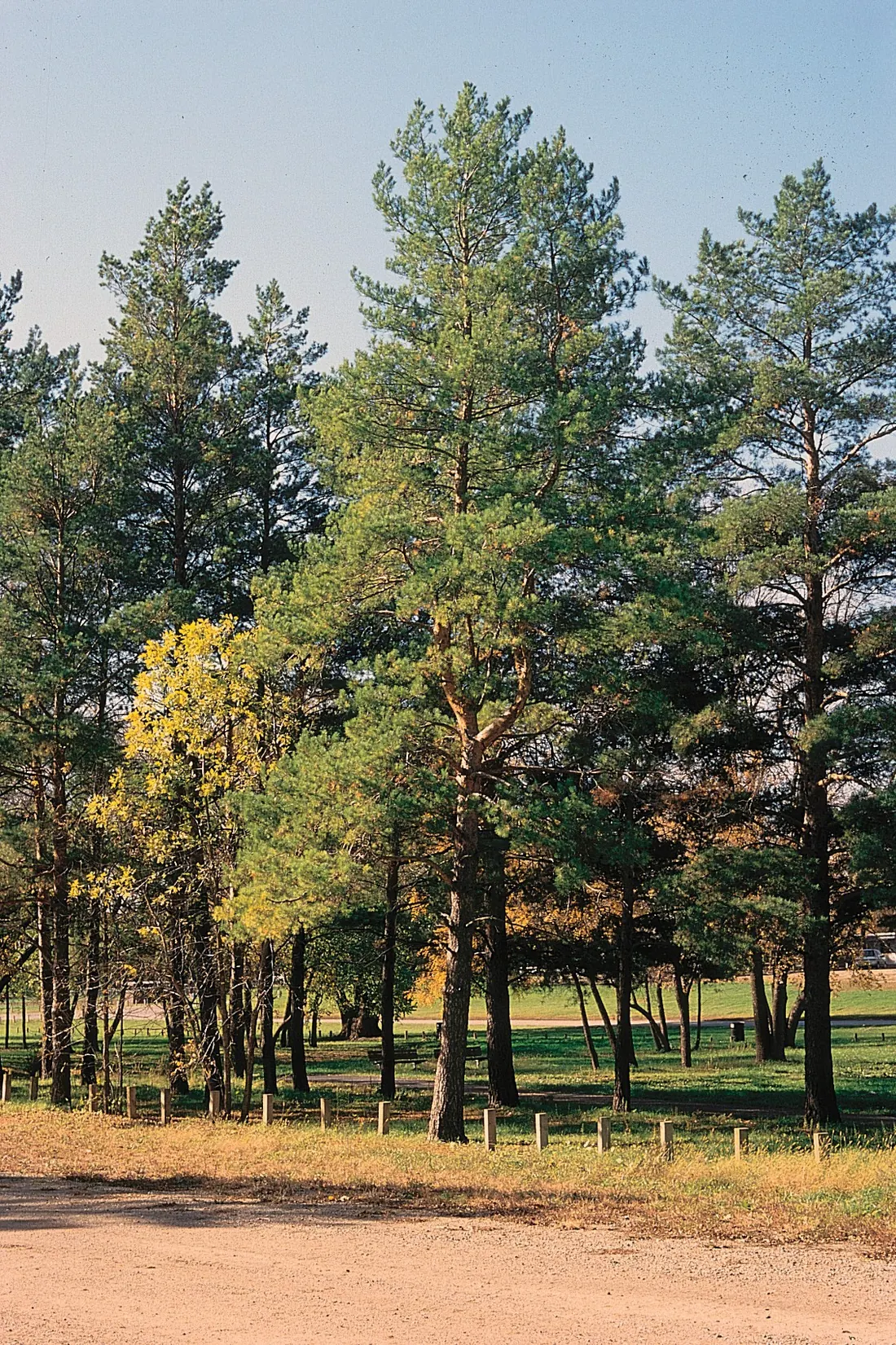
Scots pine is the easiest tree in Ireland to identify at half a mile, and the trick is to ignore the needles entirely and look at the colour of the trunk. From about halfway up, the bark of a mature Pinus sylvestris turns a warm orange-pink that catches low sunlight and appears in no other tree we grow. Once you have noticed it you will pick out every Scots pine on every skyline for the rest of your life.
It is our only native pine, though its status here is complicated: Scots pine was present in Ireland after the last glaciation, declined to near-extinction, and most of what stands today descends from reintroductions since the seventeenth century. What is not in doubt is its usefulness. Half the shelterbelts protecting Ulster farmsteads from the south-westerly have Scots pine in them.
How to identify a Scots pine
Bark. Deeply fissured, grey-brown and plated near the base; smooth, flaking and distinctly orange or salmon-pink in the upper trunk and branches. This two-tone trunk is diagnostic.
Needles. In pairs, twisted, blue-green, 4 to 7cm, held in a short sheath. Counting needles per bundle is the standard method for separating pines: two needles means Scots pine (or Corsican, which has much longer, straighter, darker needles); five means one of the white pines; three means something else again.
Cones. Small, pointed, grey-brown, 3 to 6cm, taking two years to ripen.
Crown. Young trees are conical; mature open-grown trees develop the characteristic flat, spreading, almost umbrella-like top on a long clean trunk. That silhouette against the sky is unmistakable in Irish parkland.
The role Scots pine plays here
Three things explain why it is where it is.
Shelter. Being evergreen, Scots pine provides year-round wind protection where deciduous shelterbelts fail exactly when needed, in winter storms. Farmsteads across Antrim, Down and Tyrone were planted with pine belts for that reason.
Poor ground. Scots pine thrives on thin, acid, sandy and peaty soils where broadleaves struggle, which describes a great deal of upland Ireland.
Landmarks. Lines and clumps of Scots pine were traditionally planted as boundary markers and, in some areas, as signals of hospitality along drove roads. When you see three pines on a hilltop with no forestry around them, that is usually a deliberate historical statement rather than an accident.
Ecologically it is worth far more than its non-broadleaf status suggests: red squirrels, crossbills and a specialised invertebrate fauna all depend on pine, and in Northern Ireland's red squirrel strongholds, pine stands are part of the conservation strategy.
Risks specific to pine
Scots pine behaves differently from broadleaves and the assessment questions differ accordingly.
Windthrow, not breakage. Pine has a strong stem and comparatively brittle branch attachments, but its most common serious failure mode on shallow or waterlogged soils is uprooting entire, especially where a belt has been thinned or an adjacent shelterbelt removed. Trees grown in a group have never carried full wind loading individually; expose them and the next gale finds out. If you are considering felling part of a pine belt, that decision should be assessed before it happens rather than explained afterwards.
Loss of lower branches. Pines self-prune in shade, so a mature pine in a belt has a long bare trunk and all its weight at the top. That raises the leverage on the root plate and makes the crown-heavy silhouette a genuine factor in exposed situations.
Deadwood. Dead pine branches are brittle, hold on for years and fall in wind. Over a car park or a path that matters.
Red band needle blight. Dothistroma septosporum causes needles to develop red bands and die from the tip, thinning crowns from the bottom up. It affects Corsican and lodgepole pine severely and Scots pine less so, but it is present here and worth recognising.
Honey fungus and root decay. As with any species, decay at the base is the finding that changes decisions. Bracket fungi at the foot of a pine near a target warrant a proper tree risk assessment.
Pine on development sites
Two points come up repeatedly in survey work. First, mature Scots pines are often the tallest trees on a site and, being evergreen, they dominate views year-round, which usually means a high amenity rating under BS 5837:2012. Second, a pine's root system is typically wide and shallow on Irish soils rather than deeply anchored, so the root protection area is genuinely functional rather than notional, and cutting into it has consequences for stability, not just health.
The most common mistake is treating a shelterbelt as a line of individual trees. It is a single wind-management system, and removing part of it changes the loading on the rest. Our BS 5837 tree survey work assesses belts as belts for exactly that reason.
Planting Scots pine
For poor, acid or free-draining ground, few trees serve better, and a pine belt planted now will shelter a site for a century. It is worth being precise about exposure, though: Scots pine is frost-hardy, drought-tolerant and reasonably windfirm, but it is not indifferent to a hard site. Provenance, soil depth, drainage and the structure of the belt around it all bear on how well it performs, and on the most severely exposed coastal ground other species do better. Give it space, too: Scots pine reaches 25 to 35 metres and will not tolerate being clipped into shape. It also dislikes waterlogging, so for wet ground use alder instead.
Where a planning condition calls for screening that works in winter, pine deserves consideration far more often than it gets it. Our tree planting advice covers species selection for shelter and screening as well as amenity.
Scots pine and mortgage reports
Pines raise a different question from broadleaves during a property purchase.
Conifers are generally lower water demand than the broadleaves most associated with clay shrinkage, so the subsidence question is usually less prominent. What matters with a mature Scots pine is height and exposure: a tall, clean-stemmed pine with all its weight in the upper crown, standing within falling distance of a house, is a legitimate thing for a surveyor to ask about.
The honest answer depends on the root plate and the shelter around it. A pine that has stood in a belt for eighty years is in a very different position from one left standing alone after its neighbours were cleared.
If a lender or surveyor has raised pines at a property you are buying, our mortgage tree reports address the question directly, usually within 48 to 72 hours of the site visit.
Advice on your pines
Whether it is a single specimen near a house, a belt you are thinking of thinning, or pines within a development boundary, the questions worth answering early are how exposed the trees will be after the work and what the root plate is sitting in.
Send us the site details and you will get a clear view before anything irreversible happens.