
Alder Tree Identification, Wet Ground and Care in Northern Ireland
The tree that grows where nothing else will, fixes its own nitrogen and hardens underwater. Alder identification, its uses on wet sites, and the disease to watch.
Written by John McNamara, arboricultural consultant, McNamara Tree Consultancy. Holds Professional Tree Inspection (PTI) certification and is an Associate Member of the Arboricultural Association. View John's qualifications and experience
If you are standing on ground that squelches and there is a dark, upright tree growing happily in it, you are almost certainly looking at alder. Alnus glutinosa is the specialist of wet places: riverbanks, loughshores, drains, flushes and the boggy corner of the field that defeats everything else. Half of Northern Ireland's difficult ground is alder country, and the species solves problems that no amount of drainage will.
It is also the only common broadleaf here that fixes its own nitrogen, and that single fact explains most of what it does.
How to identify an alder
Cones. Small, woody, dark cones that persist on the twigs all year, including through winter. No other native broadleaf carries anything like them, and they are the fastest identification in any season.
Catkins. Long purple-brown male catkins hanging in bunches from late winter, well before the leaves, alongside the small upright female flowers that become the cones.
Leaves. Rounded, sometimes almost heart-shaped in reverse with a notched or blunt tip rather than a point, dark green, and slightly sticky to the touch when young, which is what glutinosa refers to. If the leaf is rounded at the end rather than pointed, that is alder.
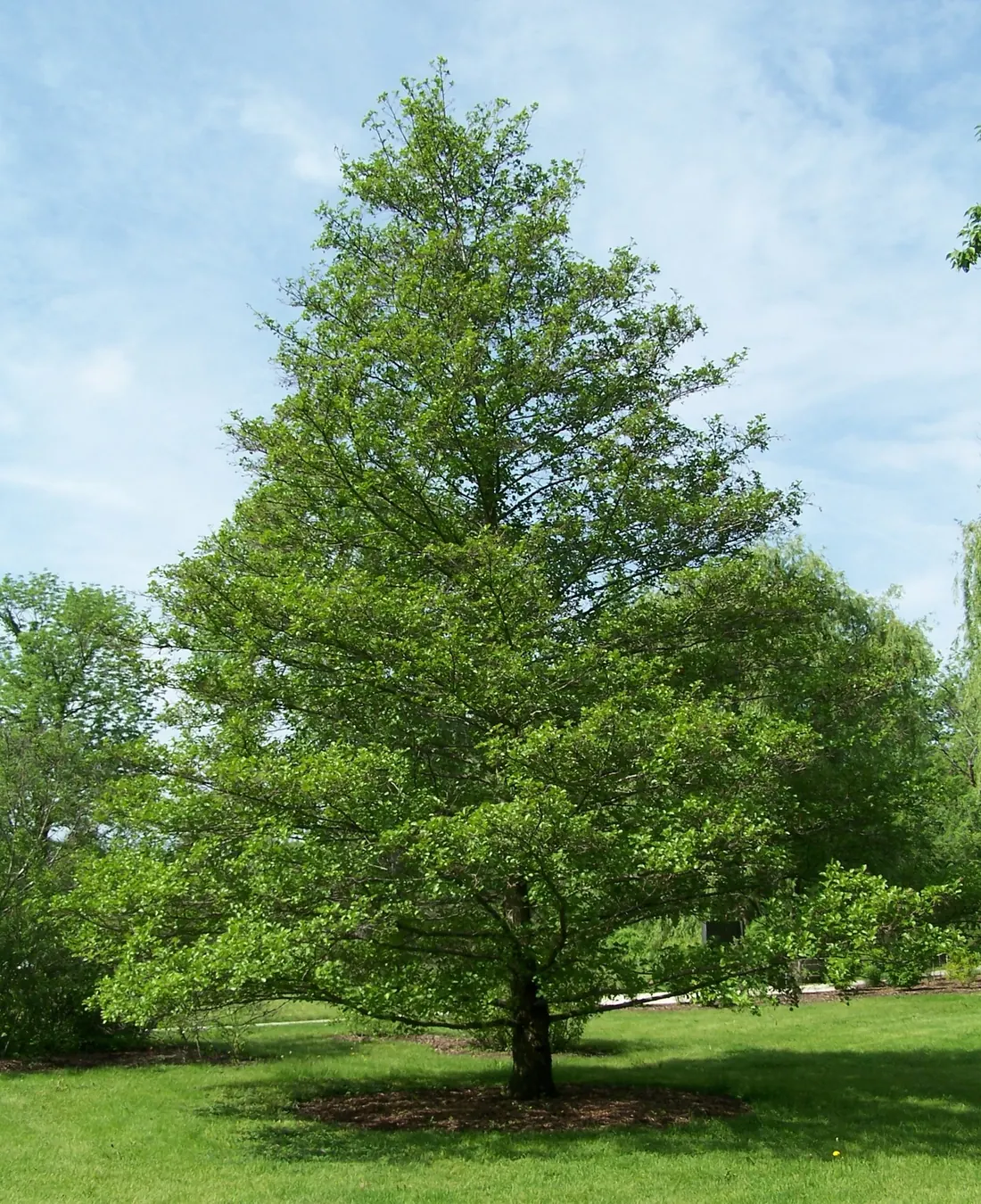
Bark and form. Dark grey-brown, fissured with age. The tree is usually conical and upright rather than spreading, often multi-stemmed where it has been cut in the past.
Autumn. Alder stays stubbornly green and then drops its leaves still green, contributing nothing to autumn colour and everything to soil fertility.
Why alder matters on wet sites
Alder roots host Frankia, a bacterium that fixes atmospheric nitrogen in root nodules, so the tree manufactures its own fertiliser and enriches the ground around it. That is why alder colonises bare, poor, waterlogged ground first and why it is such an effective nurse species: plant alder with oak on a hard site and the oak grows better for it.
Its second trick is tolerance of saturation. Alder roots survive in ground where oxygen is scarce and other species drown. This makes it invaluable for riverbank stabilisation, where the root mat binds the bank against erosion, and for the wet field corners that would otherwise be unplantable.
The old craft detail is the good one: alder timber is soft and perishable in the open but remarkably durable when permanently submerged, because the wood is denied the oxygen that decay fungi need. It was the traditional wood for sluice gates, water pipes and clog soles, and alder piles are among the timbers traditionally cited in the foundations of Venice. A tree that rots in the air and hardens under water is a useful thing to know about when specifying anything near a watercourse.
Alder and development sites
Alder's habit of growing exactly where the water is puts it in the path of a lot of construction. Two consequences follow.
First, if alder is present, the ground is likely to be wet, and wet ground plus construction traffic equals severe compaction. Alder's root protection area needs treating seriously not only for the tree's sake but because the site conditions that suit it are precisely those that suffer most under machinery.
Second, alder along a watercourse is rarely just a tree matter. Riparian vegetation carries ecological weight, may involve consenting for works near a river, and will often be the subject of a planning condition. Getting the tree survey and the wider constraints considered together at design stage saves a lot of retrofitting; our BS 5837 tree survey work flags where an arboricultural issue is really a drainage or ecology issue in disguise.
The disease to know: Phytophthora alni
The significant health threat to alder in these islands is Phytophthora alni, a water-borne root pathogen that has caused serious losses in riverside alder across Britain and Ireland since the 1990s.
The signs are distinctive once known. Crowns thin and leaves become small, sparse and yellowish. Trees produce unusually heavy cone crops as a stress response. Most tellingly, dark or rusty tarry spots and bleeding patches appear on the lower trunk near ground level, sometimes with black staining running down the bark.
Because it spreads in water, it moves downstream through a catchment, and there is no treatment. Management is about hygiene, avoiding moving infected material or contaminated soil between sites, and about assessment: a dying alder over a footpath or a road is a risk case like any other. If you have alder showing bleeding lesions at the base, a tree risk assessment will tell you what needs to happen and in what order.
Planting alder
For wet ground alder is often the correct and obvious answer, and it establishes fast. Two cautions. It is short-lived by the standards of oak or beech, typically 60 to 100 years, so plan for succession rather than permanence. And it seeds prolifically into damp ground, which is a virtue in a wet corner and a nuisance in a managed garden.
Where planting is required to discharge a landscaping condition on a wet site, alder frequently outperforms the species people expect to see specified. Our tree planting service chooses from what the ground will actually support, which on much of this island means taking wet ground seriously rather than fighting it.
Alder and mortgage surveys
Alder in a garden tells you something about the ground before you look at anything else: it is wet, or it was.
For a property purchase that is often the more useful observation. Alder is a moderate water demand species and not one of the usual subsidence suspects, but the ground conditions it favours bring their own questions about drainage, and a mature alder beside a watercourse raises bank stability and access rather than foundations.
Where a lender's surveyor has flagged alder, the sensible report covers the tree's condition, in particular any dark bleeding at the base that would indicate Phytophthora, its distance from the building, and whether the wet conditions it indicates have any bearing on the property.
Our mortgage tree reports set that out clearly for the lender, and if the tree is close to proposed works, a BS 5837 tree survey is the appropriate next step.
Advice on alder
Whether it is a riverside stand, a boundary line or a single tree in wet ground near a proposed build, alder rewards early advice because the constraints attached to it are usually about water as much as about trees.
Send us the details with the site location and what is proposed, and you will get a clear view of what matters and what does not.