
Silver Birch Identification, Garden Suitability and Care in Northern Ireland
The garden tree people most often plant and most often worry about. Silver birch identification, how close to a house is sensible, and how long it will really live.
Written by John McNamara, arboricultural consultant, McNamara Tree Consultancy. Holds Professional Tree Inspection (PTI) certification and is an Associate Member of the Arboricultural Association. View John's qualifications and experience
Silver birch is the tree people plant when they want a tree and are not sure which one. White bark, light shade, quick results and a delicate outline: it does a great deal right for a small garden. It also generates a steady stream of anxious enquiries about roots, drains and foundations, most of which turn out to be misplaced, and one genuine issue that almost nobody asks about, which is how long the tree will actually live.
How to identify silver birch
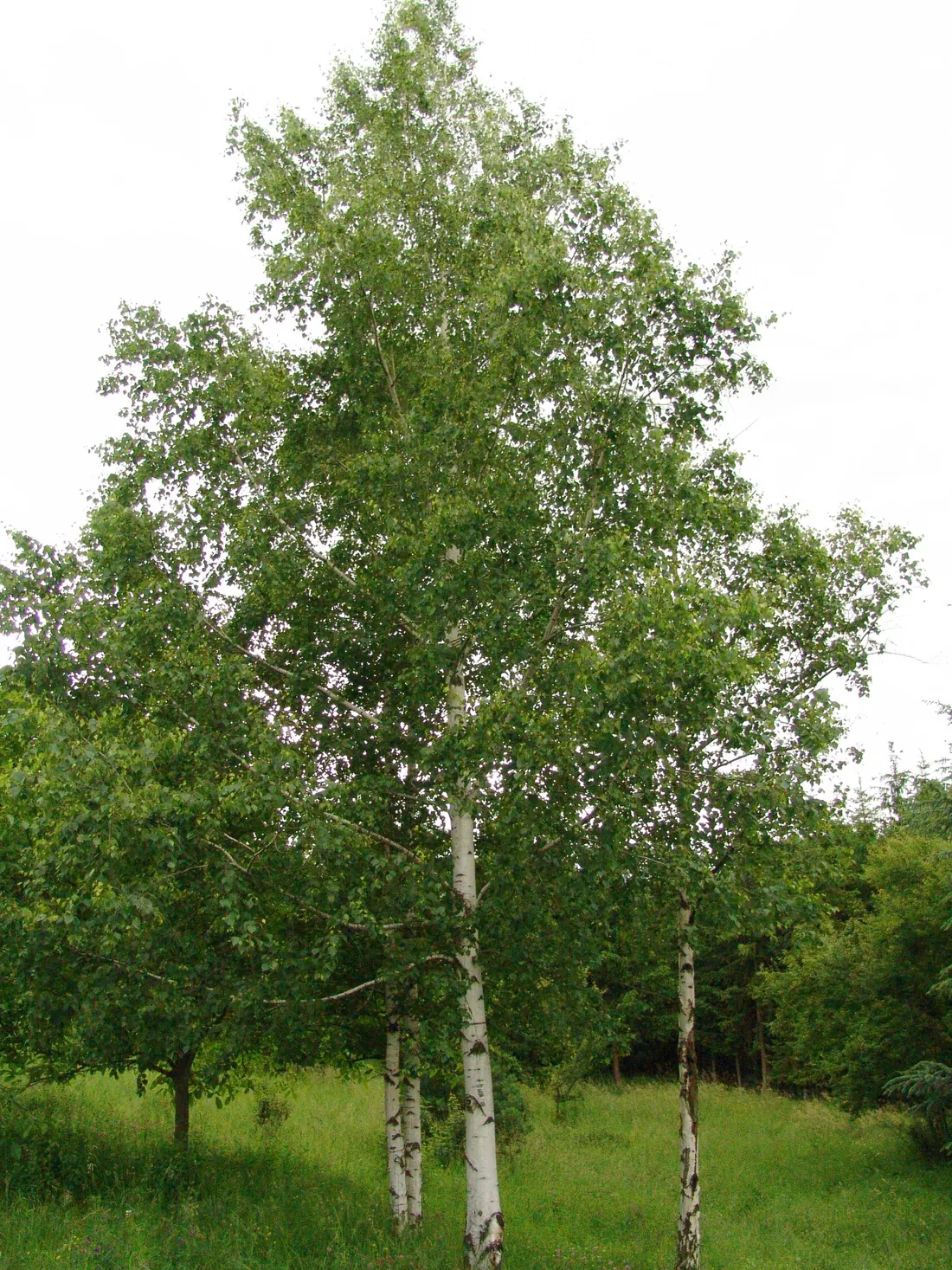
Bark. White and papery, peeling in horizontal strips, developing rough black diamond-shaped fissures at the base of older trees. That combination of a white upper trunk and a blackening, rugged base is diagnostic.
Shoots. Fine, whippy and drooping at the ends, with small warty bumps you can feel by running the shoot through your fingers. Downy birch (Betula pubescens), which is at least as common in Ireland and more so on wet upland ground, has upright rather than drooping shoots, downy young twigs without warts, and duller, greyer bark. In practice the two hybridise freely and plenty of Irish birch sits between the descriptions.
Leaves. Small, triangular, doubly toothed, on a slender stalk, turning clear yellow in autumn. Silver birch leaves have a distinctly wedge-shaped base and long-pointed tip; downy birch is rounder.
Overall. Light, airy, moving constantly in wind. Birch casts one of the lightest shades of any tree, which is why it is one of the few large-ish trees you can underplant successfully.
Is it safe to plant near a house?
This is the question we are asked most, so here is the straight answer.
Birch has a shallow, fibrous, spreading root system that stays largely in the top half-metre of soil, and it is a comparatively low water demand tree, so it is not among the species most often implicated in clay shrinkage subsidence: those are poplar, willow, oak and elm. Tree-related subsidence depends first on whether shrinkable clay is present beneath the building, and it is far less common in Northern Ireland than in the clay belts of south-east England.
That said, sensible spacing still applies. Ten metres or more from a building is comfortable; five metres is tighter than ideal but rarely a structural problem on typical Irish ground. The realistic nuisances of a close birch are not structural at all: fine surface roots competing with lawns and borders, heavy seed and catkin litter, and honeydew from aphids in summer.
Drains are the exception worth respecting. Birch roots do not break sound pipework, but like any tree they will exploit a joint that has already failed, so an old clay drain run beside a birch is worth knowing about.
If a lender's surveyor has raised trees near a property you are buying, that concern is answerable in writing rather than by felling: see our mortgage tree reports, which address falling distance, root influence and future growth in the format underwriters expect.
The thing nobody mentions: birch is short-lived
A silver birch in a garden setting is doing well to reach 60 to 80 years, and many decline noticeably from 40. That is a fraction of oak or beech, and it changes how you should think about one.
The practical implications are worth stating plainly. A birch planted when a house was built in the 1970s is now an old tree, and the crown dieback its owner is worrying about is usually senescence rather than a treatable disease. Fungal fruiting bodies such as the birch polypore (Fomitopsis betulina), a smooth, hoof-like bracket, and the hoof fungus (Fomes fomentarius) tend to appear as the tree ages, and both indicate decay in a species that has little capacity to compartmentalise it. Birch also has a habit of failing rather suddenly once decay is established, because the wood is not strong.
None of that is cause for panic, but a mature birch overhanging a house, a road or a play area is exactly the case for a proportionate tree risk assessment rather than assumption in either direction.
Managing birch well
Birch does not respond well to heavy pruning. It bleeds sap prodigiously if cut in late winter or spring, it occludes wounds poorly, and topping it produces a shape that never recovers its character. The correct approach is minimal: remove deadwood, lift the crown modestly if you need headroom, and otherwise leave it alone. If the tree is genuinely too big for its space, the honest answer is usually replacement rather than repeated reduction.
If you are pruning for access, do it in late summer or early autumn when sap flow is low.
Planting birch, and better alternatives
Birch remains an excellent choice for the right small garden: quick, light, wildlife-rich and beautiful in winter. Plant it in a group of three if you have room, which is how it looks best and how it grows in the wild.
Where clients want something with birch's charm but a longer life, we often suggest rowan for small spaces or hornbeam where a screen is wanted. Where the aim is carbon and permanence, birch is not the tree; see our guide to trees that fight climate change and our tree planting advice for species matched to the site rather than the fashion.
Silver birch and mortgage reports
Birch generates more unnecessary anxiety during property purchases than any tree on this list, so it is worth being clear.
Birch is classed as a low water demand tree, the lowest of the categories used in foundation guidance, alongside holly, hornbeam and hazel. It is not among the species associated with clay shrinkage subsidence, and on the great majority of Northern Ireland ground a birch near a house is not a structural concern.
Where a lender does query one, the more relevant issue is usually the tree's age and condition, because birch is short-lived and fails relatively suddenly once decay is established. A 60-year-old birch overhanging a roof is a condition question, not a foundations question, and it has a straightforward answer.
If trees have been raised during your purchase, our mortgage tree reports address falling distance, root influence and future growth against the exact wording of the lender's request, typically within 48 to 72 hours of the visit.
Worried about your birch?
The useful questions for a mature birch are its age, the state of the base, and whether there are brackets or deadwood over a target. Those three determine everything.
Send us the details, including anything you have noticed at the trunk base, and you will get a straight assessment, including "it is fine, leave it" when that is the answer.