
Oak Tree Identification, Protection and Care in Northern Ireland
Oak grows for 300 years, rests for 300 and declines for 300. Here is how to identify one, how to read its decline honestly, and how to care for an old one.
Written by John McNamara, arboricultural consultant, McNamara Tree Consultancy. Holds Professional Tree Inspection (PTI) certification and is an Associate Member of the Arboricultural Association. View John's qualifications and experience
There is an old saying about oak: three hundred years growing, three hundred years resting, three hundred years declining. It is a rule of thumb rather than a measurement, and few oaks read it, but it captures something important. An oak operates on a timescale that makes most of our management decisions look impatient, and the single most useful thing an owner can learn is when to intervene and when to leave well alone.
Oak is also the tree owners most often assume is untouchable, and the one where the legal position is most often misunderstood. If you are planning anything near a mature oak, that position is worth establishing first rather than last.
How to identify an oak tree
Leaves. Deeply lobed with rounded lobes, unmistakable in outline. The two natives are separated by their leaf stalks and acorns: pedunculate oak (Quercus robur, the English oak) has almost no leaf stalk but long stalks on its acorns; sessile oak (Quercus petraea, Ireland's more characteristic upland oak) is the reverse, with a clear leaf stalk and acorns sitting tight against the twig. In the wetter, more acidic ground of the Sperrins, Mournes and Glens you are more often looking at sessile oak.
Bark. Deeply and irregularly fissured into vertical ridges, grey-brown, becoming almost geological on ancient trees. Nothing else in an Irish hedgerow has bark that heavy and craggy.
Buds. Clustered at the tip of the shoot, several together, blunt and orange-brown. That cluster of terminal buds is a fast winter identifier.
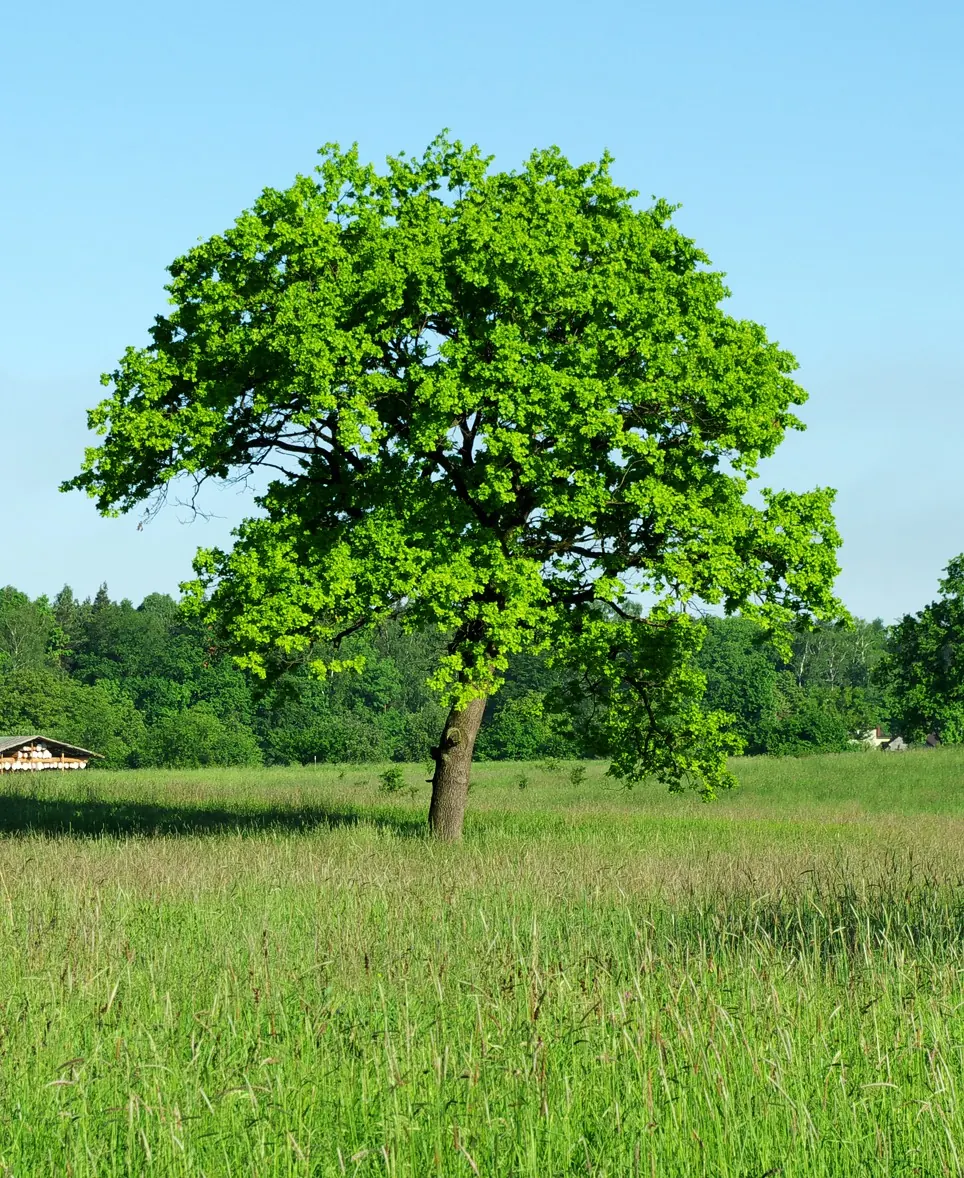
Silhouette. Heavy, twisting limbs held at wide angles, often descending and rising again, with a broad crown far wider than it is tall on an open-grown tree. The characteristic look of an oak is muscle rather than reach.
The 300-year detail that matters: retrenchment
Old oaks do something that alarms people who do not expect it. As they enter maturity they shed their outer canopy and grow a smaller, lower crown within it, a process called retrenchment. Dead branches appear in the upper crown, sometimes protruding above the leaves, and the tree looks, to an untrained eye, as if it is dying.
It usually is not. Retrenchment is how an oak manages its own decline over centuries, reducing its water demand and wind loading while its heartwood hollows. A hollow oak is not a failing oak: hollowing is a normal, even advantageous, part of the species' life history, and a hollow cylinder is structurally efficient. Trees are lost every year to well-meant removal at exactly the point where they were adapting successfully.
What genuinely matters is whether the tree's remaining structure is sound where it matters, and what sits beneath it. That is a judgement, not a formula, and it is the sort of thing a proportionate tree risk assessment exists to make. The VALID approach we use is deliberately structured to avoid the reflexive felling of veteran trees that pose very little actual risk.
Tree Preservation Orders: what they actually are
A point worth clearing up, because it is widely misunderstood. Tree Preservation Orders are not species-based. There is no list of protected species, and an oak has no more inherent legal status than a sycamore or a leylandii. A TPO is a planning instrument: a council makes one in the interests of amenity, covering whichever specified trees, groups or woodlands it chooses, and in practice orders are most often made where trees are perceived to be under threat, which usually means where development is proposed or anticipated.
So the question is never "is it an oak?" but "is this particular tree covered?". Where a TPO does apply, cutting, topping, uprooting or wilfully damaging the tree without the council's consent is an offence. Conservation area status works differently again, requiring notice to the council before works so that it has the opportunity to make an order.
The practical advice is the same regardless of species: before any work, and before any excavation near the root zone, ask the relevant council's planning department whether the tree is covered. It takes one email and it prevents the most expensive category of mistake we see. A TPO does not prohibit work outright, it requires consent, and a well-evidenced application for justified work is routinely granted. What it prevents is unilateral action.
If your project involves trees and you are unsure of the position, we deal with this constantly through our BS 5837 tree survey work. And if your oak is covered and genuinely needs work, we prepare and submit the tree works application, with the condition evidence the council expects to see.
Common oak problems
Acute oak decline. A serious condition recorded mainly in central and southern England, showing as dark, weeping vertical fissures on the trunk that stain the bark. It is associated with a bacterial complex and frequently with the beetle Agrilus biguttatus. It is not a routine finding here, but the symptoms are worth recognising so that they are reported rather than missed.
Powdery mildew. The white bloom on late-summer oak leaves, especially on regrowth. It is unsightly and stresses young trees; on a mature tree it is a nuisance rather than a threat.
Root compaction. By far the commonest cause of decline in parkland and amenity oaks. Vehicles, stored materials, or simply livestock and people congregating in the shade compress the soil and starve the fine roots of air. Fencing an oak's root zone is one of the highest-value, lowest-cost interventions available to any landowner.
Soil level changes. As with beech, adding soil over the root area is silently lethal. Oak tolerates more than most, but not much more.
Caring for a veteran oak
The best practice for old oaks is unglamorous and mostly negative: keep machinery, storage and traffic out of the root zone, do not tidy away the deadwood unless it threatens something, do not raise or lower ground levels, and let the ground beneath grow rough rather than mown. If the crown genuinely needs reducing for safety, a phased, conservative reduction over several years is vastly better than one heavy cut.
If you are planting oak rather than managing one, plant it where it has a century of room. Oak is the finest long-term tree we can put in the Irish landscape and the worst possible choice for a small garden five metres from a house. Our tree planting advice always starts from the space available in fifty years, not five.
Oak and mortgage tree reports
Oak is the species most likely of any on this list to prompt a lender's query, and for a legitimate reason: it is classed as a high water demand tree in the guidance engineers and insurers use, alongside poplar, willow and elm.
Two points are worth understanding before that becomes alarming.
First, water demand only translates into subsidence risk where shrinkable clay sits beneath the foundations. Where it does not, a mature oak near a house is a magnificent asset and no threat. Establishing which situation applies is precisely what a report is for.
Second, and less well known: felling a mature high water demand tree on clay can cause heave as the soil rehydrates and swells, which is capable of doing more damage than the tree was ever going to. Removal is not automatically the safe option, and a report that recommends felling without addressing heave is incomplete.
If a lender or surveyor has raised an oak during a purchase, our mortgage tree reports answer the question properly, usually within 48 to 72 hours of the site visit.
Advice on your oak
Whether the question is a hollow trunk, a limb over a road, a possible TPO or a development close to the root zone, oak repays getting the assessment right rather than acting quickly.
Send us the details, including what you have noticed at the base of the tree, and you will get an honest view, including whether the tree needs anything done at all.