
Horse Chestnut Identification, Leaf Miner and Bleeding Canker in Northern Ireland
Every conker tree in Ireland goes brown in August, and almost every owner worries. Here is what is harmless, what is serious, and how to tell them apart.
Written by John McNamara, arboricultural consultant, McNamara Tree Consultancy. Holds Professional Tree Inspection (PTI) certification and is an Associate Member of the Arboricultural Association. View John's qualifications and experience
No tree prompts more unnecessary worry than horse chestnut. Every August the leaves turn brown and crisp, the tree looks as if it is dying, and the phone rings. In nearly every case the cause is a small moth that does no lasting harm. In a minority of cases something considerably more serious is happening lower down the trunk, and telling the two apart is the single most useful thing an owner of a conker tree can learn.
Aesculus hippocastanum is not native here, arriving from the Balkans in the seventeenth century, but it has been planted so extensively in demesnes, avenues, school grounds and village greens that it feels native. The great flowering avenues of Northern Ireland's estate landscapes are largely horse chestnut.
How to identify a horse chestnut
Leaves. Palmate, with five to seven large leaflets radiating from a single point like fingers from a palm, up to 60cm across on vigorous shoots. Nothing else common here has that hand-shaped leaf.
Buds. Large, fat and famously sticky, glossy red-brown, sitting in opposite pairs. Snap one open in February and the whole compressed inflorescence is inside, ready to unfold.
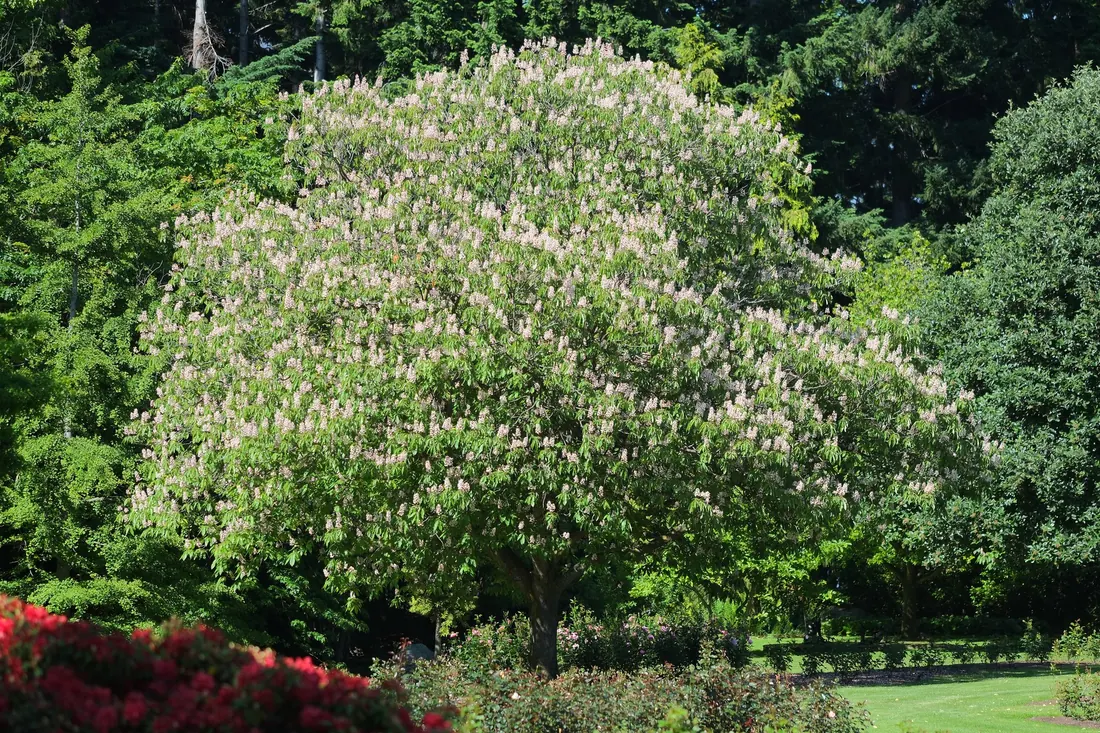
Flowers. Upright white "candles" 20 to 30cm tall in May, each with a yellow blotch at the base of the petals that turns pink or red once the flower has been pollinated, a signal to bees not to waste a visit. It is one of the best pieces of botanical engineering in any tree you will meet on a school run.
Fruit. Spiny green cases containing the conkers. Sweet chestnut, a different family entirely, has long narrow toothed leaves and much spinier, denser husks holding edible nuts. Horse chestnut conkers are not edible.
Bark and form. Grey-brown, scaly, flaking in plates with age. A big, domed, heavy tree, often with lower branches sweeping right down to the ground when open-grown.
The August browning: leaf miner
The horse chestnut leaf miner, Cameraria ohridella, was first recorded in Britain in 2002 and reached Ireland later, and is now widespread. The larvae mine between the leaf surfaces, creating blotchy brown patches that spread until the whole leaf looks scorched, usually from July onward. Badly affected trees can look autumnal by mid-August.
Here is the important part: it looks catastrophic and is essentially cosmetic. The tree has already completed most of its season's growth by the time damage peaks. Repeated years may reduce conker size and mildly reduce vigour, but leaf miner does not kill horse chestnuts. There is no practical control for a mature tree, and none is warranted. Raking and removing fallen leaves in autumn reduces next year's population slightly, which is worth doing if the tree is in a garden and you feel like being useful.
If your conker tree browns in August every year and flowers well every May, it is doing fine.
The one to take seriously: bleeding canker
Bleeding canker is a different matter. Caused principally by the bacterium Pseudomonas syringae pv. aesculi, it produces dark, rusty or black liquid oozing from cracks in the bark of the trunk and main limbs, drying to a tarry crust. Beneath the bleeding point the bark and underlying tissue die. Where lesions spread far enough to girdle the stem, everything above dies with it, and crown dieback follows.
The distinction to hold onto: leaf miner is in the leaves, bleeding canker is on the trunk. A tree can have both, and the leaf damage will distract from the more important signs.
Bleeding canker's course is unpredictable. Some trees wall off the infection and recover; others decline steadily over years. What matters for an owner is that extensive cankering can weaken the structure of the stem and limbs, on a species that already carries heavy, long, low branches in full leaf. A cankered horse chestnut over a car park, a playground or a road needs proper assessment. That is a textbook case for a tree risk assessment, where the point is not to condemn the tree but to quantify what is actually likely to fail and what sits beneath it. Where the tree stands in a garden with no obvious target beneath it, a tree condition survey is the proportionate step: it records how far the cankering has spread and whether the tree is walling it off, and gives you a written basis for choosing between monitoring and removal.
Do not prune a cankered tree unnecessarily; each wound is another entry point. And never remove bark to "see how far it goes", which spreads the problem.
Conkers, children and liability
Horse chestnuts in school grounds and public parks raise a specific question every autumn: children throwing sticks into trees, and falling conkers. In practice, the risk from conkers themselves is negligible, and the legal expectation on a landowner is reasonable, proportionate management, not the elimination of every conceivable hazard. Health and safety guidance on tree management has been consistent on this point: the substantial benefits of trees in public spaces are weighed against a very low probability of harm, and a sensible, proportionate inspection regime is what is expected.
What matters is having assessed the tree sensibly and recorded that you did. A documented inspection cycle discharges the duty; felling a healthy tree because someone might throw a stick at it does not.
Horse chestnut on development sites
Because so many horse chestnuts stand in old demesnes and institutional grounds, they turn up regularly on sites being redeveloped. They are frequently the largest and most visually dominant trees present, which means high amenity value and often a category A or B rating under BS 5837:2012, and prominent trees of this kind are among those a council may choose to make a Tree Preservation Order over. Their heavy, low, spreading limbs also mean large crown spreads and correspondingly large root protection areas, which shapes a layout more than clients expect. Our BS 5837 tree surveys deal with this every season.
Should you plant one?
Only if you have a park. A horse chestnut needs 20 metres of space in every direction to be itself, and planting one in a suburban garden guarantees a conflict in thirty years. If you want the candles at a manageable size, the red horse chestnut (Aesculus × carnea) is smaller and markedly more resistant to leaf miner. Our tree planting advice will match the tree to the space you actually have.
Horse chestnut and mortgage surveys
Horse chestnut is a big tree in small places, which is why it appears in mortgage reports so often.
It is a moderate water demand species, so the foundations question depends, as always, on whether shrinkable clay is present. What draws the surveyor's eye is usually the physical scale: heavy low limbs sweeping toward a roof, a crown spread that overhangs the whole garden, and conkers and leaf fall on a drive.
Condition is the other trigger, and this is where the distinction earlier in this article matters. A tree browned by leaf miner looks alarming in a survey photograph taken in August and is not a defect. Dark bleeding on the trunk is, and it belongs in the report.
Our mortgage tree reports separate the two clearly for the lender, addressing falling distance, root influence and future growth in the format underwriters recognise.
Worried about a conker tree?
Look at the trunk, not the leaves. If there is dark bleeding on the bark, get it assessed. If the leaves are brown and the bark is clean, enjoy the tree.
Send us the details, describing both the leaves and the trunk, and you will get a straight answer either way.