The Week in Review: QTRA Training in Carlisle
A week of professional development, tree risk assessment, beautiful autumn scenery and rather less sleep than I'd have liked!
Written by John McNamara, arboricultural consultant, McNamara Tree Consultancy. A VALID Accredited Validator and Registered QTRA User who also holds Professional Tree Inspection (PTI) certification and is an Associate Member of the Arboricultural Association. View John's qualifications and experience
This week took me away from Northern Ireland and across the Irish Sea to Carlisle, where I spent two days undertaking training in Quantified Tree Risk Assessment (QTRA), delivered by Mike Ellison.
As an arboricultural consultant, continuing professional development is an important part of my work. Tree risk assessment is a significant element of the services I provide, and I'm always keen to explore different approaches, challenge my existing knowledge and develop a more comprehensive understanding of how we assess and manage the risks associated with trees.
Sunday: across the Irish Sea
The week began on Sunday with a flight from Belfast to Edinburgh, where I collected a hire car and made the journey south to Carlisle through the beautiful landscapes of the Scottish Borders.
With autumn well underway, the scenery was spectacular, and I was looking forward to two days of learning alongside fellow arboricultural professionals.
Unfortunately, my accommodation had other ideas.
Thanks to a particularly noisy guest in the room above, I managed approximately two hours of sleep before the first day of training. Not exactly the ideal preparation for a course involving probability, mathematics and risk assessment!
Monday: understanding tree risk
Despite the lack of sleep, Monday morning saw me arrive at the beautiful Talkin Tarn Country Park, near Carlisle, for the first day of QTRA training, delivered by Mike Ellison.
The first day provided an in-depth introduction to the QTRA system, exploring its underlying principles and how it can be used to inform proportionate tree risk management decisions.
QTRA uses three principal components to quantify the risk associated with tree failure:
- Target: The likelihood of a person or property being struck by a falling tree or branch.
- Size: The size of the tree or branch that could fail, and its potential to cause harm.
- Probability of Failure: The likelihood of the tree or branch failing within a specified period.
These components are combined to produce an estimated annual Risk of Harm, helping tree owners and managers make informed decisions about whether intervention is necessary.
An important part of the day involved exploring tree risk more generally, particularly the distinction between perceived danger and actual risk.
According to the National Tree Safety Group's Common Sense Risk Management of Trees, the annual risk of an individual in Britain dying as a result of a falling tree or branch is approximately 1 in 15.2 million.
It's a remarkable statistic, especially when considered alongside the considerable environmental, ecological and social benefits that trees provide.
Trees are living organisms, and no tree can ever be entirely free from the possibility of failure. The objective of sensible tree risk management is therefore not to eliminate every conceivable hazard, but to identify significant risks and manage them proportionately.
This is a principle that strongly informs my own approach to arboricultural consultancy.
Tuesday: tree biology, biomechanics and practical assessment
The second day began with a review of tree biology and biomechanics, examining how trees respond to mechanical loading, develop structural adaptations and cope with the stresses imposed by their environment.
We explored the relationship between tree form, growth, structural defects and the likelihood of failure, reinforcing the importance of understanding the biological processes underlying the observations made during a tree inspection.
Following the classroom sessions, we headed out into the grounds at Talkin Tarn to put the theory into practice.
Working through real-world examples, we assessed trees using the QTRA methodology, considering the occupancy of potential targets, the size of parts that might fail and the probability of failure.
These practical exercises were particularly valuable, providing an opportunity to apply the system in the field and discuss the reasoning behind different assessments.
The course concluded with a test designed to check our understanding of the methodology and its application.
After two intensive days, I came away with a greater appreciation of QTRA as another tool for informing evidence-based tree risk management.
Wednesday: a visit to Edinburgh Castle
With the training completed, Wednesday was spent making my way back to Edinburgh for the flight home.
Before heading to the airport, however, I managed to squeeze in a visit to Edinburgh Castle.
As well as enjoying the historic surroundings, I couldn't resist stopping to admire a particularly beautiful mature tree growing against the backdrop of Edinburgh's historic stone architecture.
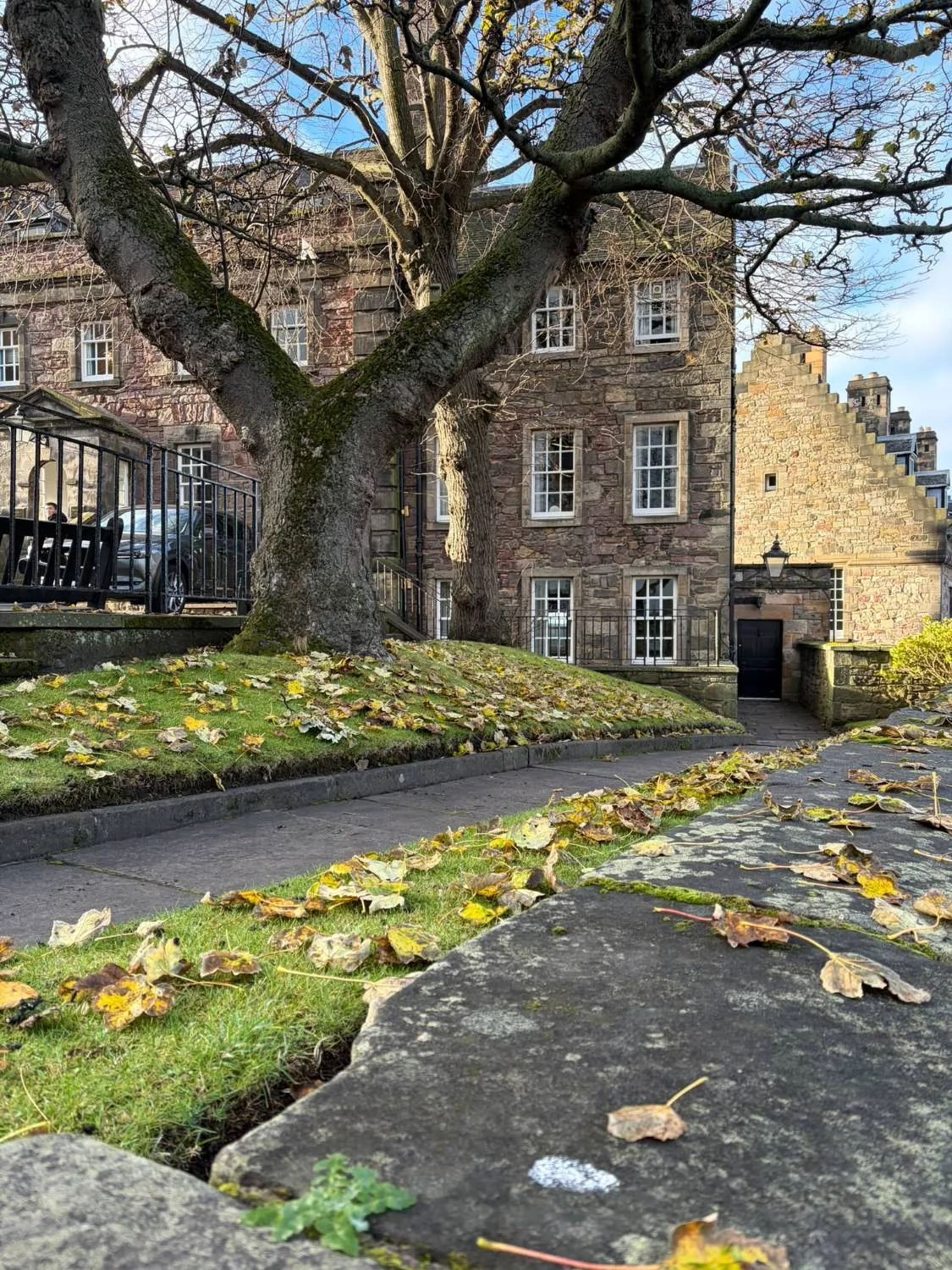
Even on a day off, it seems I'm incapable of walking past an interesting tree without stopping for a closer look!
Thursday and Friday: back to work
Unfortunately, I returned home with more than just new knowledge, having picked up a rather unpleasant bug during my travels.
Thursday was therefore spent recovering and catching up on some much-needed rest.
By Friday, however, it was back to the grindstone.
The day was spent preparing the findings of a tree risk review undertaken the previous Friday on behalf of Mid and East Antrim Borough Council.
The work involved reviewing the condition of trees, considering the risks associated with identified defects and preparing appropriate management recommendations.
It was a fitting way to round off the week, returning to the practical application of tree risk assessment after two days spent examining its underlying principles.
Final thoughts
One of the most valuable aspects of professional development is the opportunity to step away from familiar routines and reconsider the principles that underpin our work.
The QTRA training provided an excellent opportunity to do just that.
While different tree risk assessment methodologies have their own approaches, they share an important objective: supporting informed, defensible and proportionate decisions that balance public safety with the many benefits trees provide.
I look forward to incorporating what I've learned into my continuing professional practice.
And hopefully, the next training course will involve a little more sleep!
McNamara Tree Consultancy provides independent arboricultural consultancy services throughout Northern Ireland and the Republic of Ireland, including tree risk assessments, tree surveys and arboricultural advice.